The Business Case for Investing in AI Perception Management
Chatbots name only a few brands, and the rest lose sales.

AI perception management has stopped being optional. When a chatbot names only one to three brands in answer to a buyer's question, the companies left out don't lose a ranking spot, they lose the sale before anyone compares prices. This piece lays out why that shift happened, what it costs a business to ignore it, and what a company can do about it starting now.
How AI systems became primary discovery channels
Search used to hand buyers a list. Type a question into Google and you'd get ten or more blue links, each one a door the buyer could choose to open or not. AI answers work differently: a chatbot reads the question, picks one to three brands, and hands the buyer a verdict. There's no scroll, no second page, no ten more options waiting below the fold. A brand is either in that short list or it isn't, and the buyer rarely goes looking for who got left out.
That shift in format is produced by a deeper change in how these systems form opinions: a large language model sets its view of a brand during training, long before any buyer asks a question. A search engine looks something up the moment you ask. A large language model doesn't do that: it draws on patterns absorbed during training, from web pages, articles, reviews, forum threads, and whatever else counted as credible enough to shape its sense of a category. By the time a buyer types a question, the model's opinion of a brand has already been set. The sales pitch a company writes today will matter far less than the mentions, reviews, and citations that built the model's impression of that company months or years before the question was ever asked.
This is why treating generative engine optimization as a copy-editing exercise misses what's actually happening. The job isn't to write a better answer for the AI to find. The job is to have already built, across the open web, the kind of evidence an AI model trusts enough to repeat back as fact.
Why AI misrepresentation hurts revenue
Losing a page-one Google ranking stings, but it's recoverable: update the content, build a few links, fix the technical issues, and the position usually comes back within a few months. Losing a spot in an AI answer works on a different clock. Since the model's view of a brand comes from patterns set during training, a company can't just publish a new page and expect the model to notice. Shifting that view takes sustained, deliberate signal work across many sources, over time, with no guarantee of a fast payoff. The cost of neglect compounds in one direction, and the cost of catching up runs in the other: slow to fall behind, slower still to climb back.
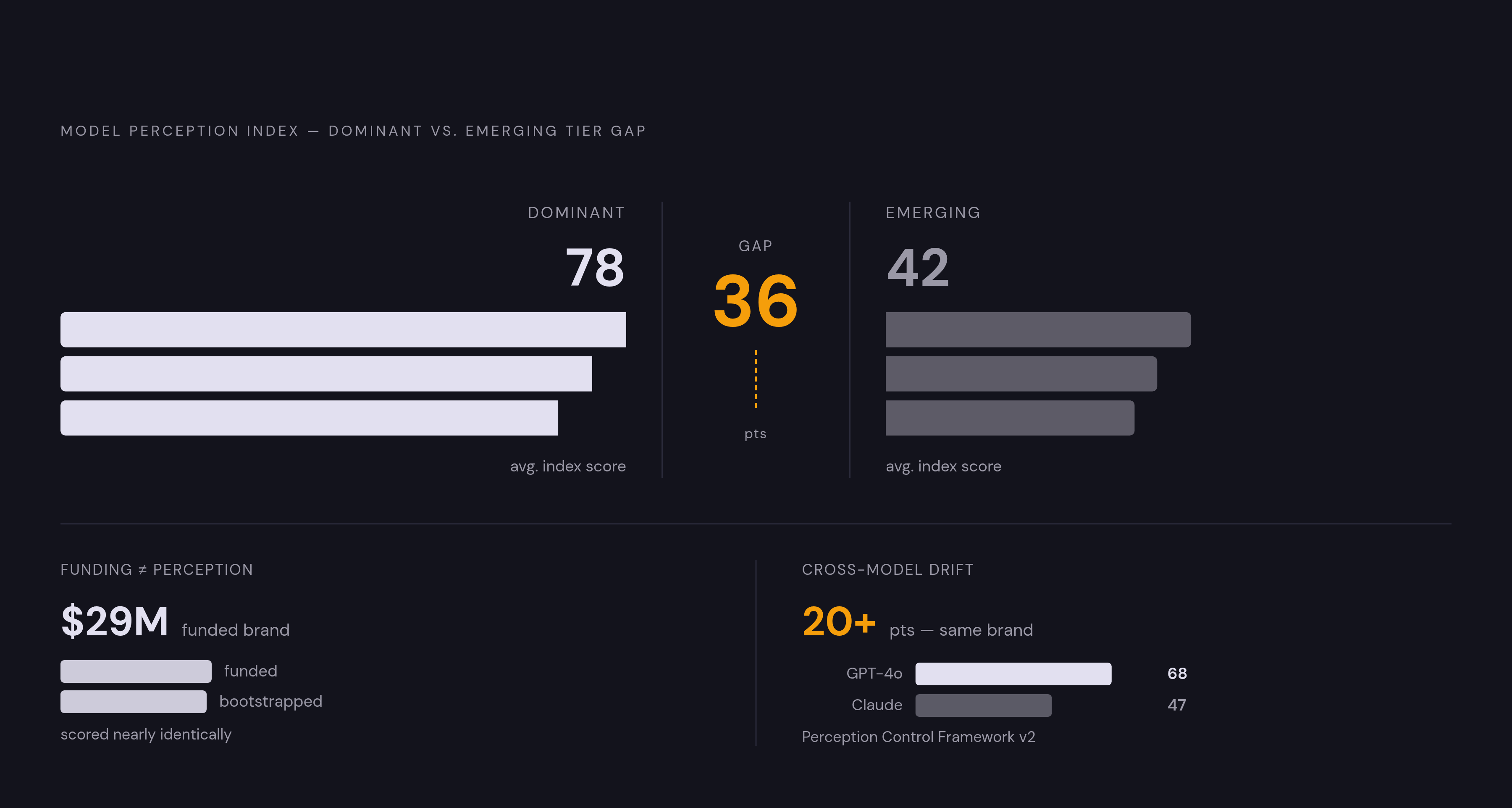
How uneven is that playing field already? The first empirical measurement of brand perception across large language models, using the Perception Control Framework v2, found a 36-point gap in model perception index scores between brands the models treat as dominant and brands they treat as emerging. That gap would be easier to dismiss if it simply tracked company size or ad budget, but it doesn't: brands with $29 million in funding scored nearly identically to bootstrapped competitors in the same study. Money doesn't buy AI favor directly. Something else does, and whatever that something is, the companies that have built it are already 36 points ahead of the companies that haven't.
The same research found something just as unsettling for anyone managing a brand across more than one AI platform: perception drift between models reaches over 20 points for the same brand. A company can be described accurately and favorably by one model while a different model, asked the same category of question, gives a muddled or outdated version of that same company. Most businesses have no system in place that would even alert them to the gap, which is the problem Scale Labs, a platform that scores how algorithms, AI systems, and humans perceive a business across 400+ signals, is built to close. They find out only when a customer mentions what ChatGPT told them, or doesn't find out at all, and loses the deal before the mismatch is ever noticed.
What signals LLMs read when they evaluate a brand
An AI model recommending a brand behaves something like a cautious analyst asked to vouch for a stranger. It wants proof, not promises, and it reaches for whatever evidence is easiest to confirm from the outside. A brand with a clear, unambiguous identity, consistent facts about itself across many sources, and some form of outside validation, reads to the model as a safe bet. A brand whose name means three different things depending on which page you land on, or whose claims about itself don't match what reviewers and forums say, reads as a risk the model would rather not take on.
Freshness plays a specific role in that calculation, and it's a more interesting role than it looks at first. A model doesn't just treat a recently updated page as more relevant to a current question, it treats recency as evidence that the claims on the page are still accurate. A page last touched two years ago isn't just stale, it starts to look like it might be wrong, and pages that read as potentially wrong lose citations to pages that don't carry that risk.
Structure matters for a related reason: a model has to extract meaning from a page quickly and with some confidence that it's extracting the right meaning. Content built with clear sequential headings, marked up with schema, and organized into passages that answer one specific question fully, gives the model less work and less room for misreading. That's why pages built this way get cited in AI answers substantially more often than pages that bury the same information inside long, promotional paragraphs.
What makes this genuinely strange for anyone used to thinking in SEO terms is how little the two systems overlap. The majority of AI Overview citations come from URLs that don't rank in the top 20 organic search results. A page can dominate Google for a given query and still never get picked up by the AI answer sitting right above those results. The two systems are reading for different things. A company's SEO strategy and its AI visibility strategy are no longer the same project, even when they're aimed at the same keywords.
And the ground doesn't stay still once a brand earns a spot. Only a minority of brands stay visible in an AI answer from one run to the next, and a smaller share still hold that visibility across five consecutive runs. A Google ranking, once earned, tends to hold until something changes. An AI citation has to be re-earned constantly, answer by answer. There's no equivalent in traditional search for a brand getting one answer from one search engine's data center and a contradictory one from another data center of the same engine, yet that's close to what happens when GPT, Claude, and Gemini are asked the same question about the same company and return three different impressions of it. No single department owns the fix for this, because the signals that drive it sit across content, SEO, digital PR, and product marketing all at once. That's part of why the gap persists: nobody's job description covers the whole problem.
The emerging measurement discipline: how AI perception is scored and tracked
None of this is vague or unmeasurable. Practitioners building this discipline track four dimensions of how AI systems represent a brand: sentiment, which shifts depending on what's being asked; share of voice, meaning how often a brand shows up at all across a defined set of category questions; citation context, which covers not just whether a brand gets mentioned but what company it keeps in that mention and how the model frames it; and entity associations, the concepts and competitors a model has learned to link to a brand's name.
The Perception Control Framework v2 proved that scoring these dimensions across more than one model is a practical, repeatable exercise. Researchers ran standardized prompts across two systems, GPT-4o and Claude Sonnet, and produced a model perception index score for each brand tested. The method is straightforward enough to replicate: ask the same questions of multiple models, score what comes back, and compare.
The market has started building tools around that same need. Peec AI announced a brand perception feature set that surfaces how AI models describe a company, what objections a model raises about it, and where the model's claims conflict with the facts the company itself publishes. A launch like that signals something about where the category is heading: this is no longer just an academic exercise, it's turning into infrastructure that businesses are expected to use.
That's the context in which a brand perception scoring platform fits. Evident scores brand perception across a large number of signals and three evaluation dimensions, built specifically to answer the question that most companies currently can't: how is this brand actually being represented across the AI systems its buyers are using to make decisions? That kind of scoring is the prerequisite for everything else in this piece. A company cannot manage a gap it cannot see, and right now, most companies can't see it. The misrepresentation rate across brands studied runs high, and the number of companies with any system in place to catch it runs low. A strategy cannot exist until measurement happens first.
The cost of waiting: how perception gaps compound over time
A 36-point gap between dominant and emerging brands didn't appear by accident, and it won't close on its own. A company starting that work today isn't just catching up to where competitors stand now, it's working against an association that's already settled into the model's training, which takes more effort to dislodge than it would have taken to build from a blank slate.
Freshness decay shows the same dynamic working passively, without any competitor having to lift a finger. A page goes stale, a model finds a fresher alternative, and the model starts citing that alternative instead. Once that substitution happens, the original page rarely earns its citations back without a direct update, and in the meantime, the fresher competitor keeps collecting the citations that used to belong to someone else. Nobody attacked the first brand. Its content just aged while its competitor's didn't.
The organizational drag makes the problem worse the longer it's left alone. Because generative engine optimization spans content, SEO, digital PR, and product marketing, a company that doesn't assign clear ownership early on ends up with a problem that's diffused across four teams and owned by none of them. Six months of that delay doesn't just cost six months of progress, it costs six months during which competitors with a clear owner kept building signal while the undefined team argued about whose job it was.
The objection to all of this is that AI answers change too fast to count as a stable target worth managing. Answers shift from one run to the next, models update on their own schedules, and a brand that earns a citation today has no guarantee of holding it tomorrow. That volatility cuts the opposite way from how it first appears. Brands that achieve both mentions and citations together, rather than one without the other, show a substantially higher likelihood of reappearing consistently across runs. Stability in AI visibility turns out to be achievable, just not as a passive byproduct of existing. It has to be built the same way the 36-point gap was built: through sustained signal work that compensates for a volatile surface, rather than through a one-time fix aimed at a system that holds still.
Concrete signal improvements that shift AI perception in measurable ways
Fixing a perception gap takes coordinated work across three areas at once: content structure, off-site credibility, and entity clarity.
On content structure, three moves matter most. Pages built around a single H1 and a clean sequential heading hierarchy get cited substantially more often in AI answers. Write passages that answer one specific question completely on their own, rather than long promotional blocks that force the model to dig for meaning across surrounding paragraphs. Apply rich schema markup so the page states its own meaning and intent directly.
On freshness, the priority is narrower and more specific than a blanket content refresh calendar. Commercial and comparison pages carry the highest citation risk when they go stale, since these are exactly the pages a buyer uses to make a decision, and freshness is the clearest proxy a model has for whether those facts still hold. Updating these pages on a quarterly cycle, at minimum, keeps that risk down.
On off-site credibility, the work has to happen somewhere other than the company's own website. AI systems source close to half their citations from community platforms, Reddit, YouTube, industry forums, where real users are discussing the category in their own words. Owned content, no matter how well structured, doesn't produce the kind of external validation these mentions carry. Alongside that, co-citation alongside established category leaders, earned through digital PR, partnership content, and analyst engagement, gives a model the fastest available signal that a brand belongs in the same tier as the names it already trusts.
These three areas are measured through a set of specific indicators practitioners are learning to prioritize: how complete a brand's schema graph is, how much share of AI answers it holds over time, a domain authority measure built specifically for AI visibility rather than the traditional SEO version, how fresh its data is, whether it has multimodal assets a model can draw on, and whether its claims carry some form of outside verification. A brand perception scoring platform like this scores against more than 70 indicators across a four-pillar evaluation framework built to answer a very specific question for a team starting this work: given limited time and budget, what should get fixed first? Knowing a gap exists is only half the job. Knowing which of dozens of possible fixes will move the score fastest turns this from a research finding into a plan a team can actually execute.