Perception Intelligence for Higher Education Institutions in AI-Era Enrollment
Colleges now lose applicants to AI summaries they can't see or measure.

A high school senior weighing nursing programs is no longer typing a university's name into a search bar and clicking through to an admissions page. She is asking ChatGPT or Perplexity to name the best programs in the region, and whatever answer she receives, however it is phrased, becomes her starting point. The enrollment funnel that higher education built its marketing operations around, search engine to.edu site to inquiry form to application, has broken down, so a nonlinear path has replaced it in which AI systems now answer questions that used to require a visit to an institution's own website. EducationDynamics has argued that students discover institutions through AI-generated answers, social platforms, and other touchpoints that legacy funnel models were never built to capture. The shift has not been gradual. EAB's Student Communication Preferences Survey found that student use of AI tools in the college search nearly doubled in six months during the Fall 2025 cycle. EducationDynamics' Marketing and Enrollment Management Benchmarks report puts the scale of the shift in sharper terms still: roughly three-quarters of education-related Google searches now surface AI Overviews, making the AI layer the default search experience for prospective students rather than an edge case institutions can afford to ignore.
Why an unfavorable or absent AI summary costs an institution an applicant
This behavioral shift carries a direct financial consequence, because AI-generated summaries do not simply inform students, they filter them. EAB's 2026 survey found that a meaningful share of students removed a college from consideration based solely on an AI-generated response, and invisible or inaccurate AI representation becomes a direct enrollment risk rather than a marketing inconvenience. The stakes are sharpened by a second trend: students researching colleges today apply to fewer institutions on average, roughly six to seven schools, which compresses the window an institution has to make a positive impression before it is cut from the list entirely. An institution that loses a place in that shortlist because an AI system described it poorly, or failed to describe it at all, has lost an applicant it will never know it lost.
That risk is compounded by what EducationDynamics has identified as a growing operational concern: the rise of the "stealth applicant," a student who forms an opinion of an institution entirely through AI-generated answers and may apply, or decide not to, without ever entering a nurture sequence. AI becomes the one touchpoint in the entire enrollment journey that an institution cannot see, measure, or respond to through the systems it already has in place. Research from UPCEA and Search Influence, surveying 705 respondents, found that half of prospective students use AI tools at least weekly, while only roughly a third of institutions have a formal AI search strategy in place.
How large language models evaluate and represent a university
Large language models do not rank universities the way a search engine ranks pages or a publication ranks programs. They synthesize a representation of an institution's credibility, fit, and authority from patterns absorbed during training and from whatever sources they retrieve at the moment of a query, and that representation is not fixed, it shifts from one model to the next. The AI Perception Index 2026, authored by Tugtekin and published on SSRN, documents substantial drift in how the same institution is perceived across different AI systems: a university can be described favorably by ChatGPT and marginalized by Gemini at the same moment, with no mechanism in place to alert the institution to the discrepancy.
The signals AI systems use to infer authority are different from traditional SEO signals. Design polish and brand identity carry little weight in this context. What determines how credible an institution appears to a large language model is citation style, factual accuracy, and the consistency of information about the institution across the sources the model draws on. Google's own classification framework treats educational content as a category that can significantly affect a person's life decisions, placing it within the "Your Money or Your Life" designation, and the expertise, experience, authoritativeness, and trustworthiness signals search systems use carry amplified weight when that content surfaces through AI-driven search. Signals generated off an institution's own site, press coverage, faculty mentions in outside publications, and third-party citations, function in this environment as citation signals that AI systems draw on directly, not merely as backlinks that improve a page's search rank, so an institution's credibility in AI outputs depends partly on how often credible outside sources reference it.
Why most institutions cannot see how AI systems represent them
The difficulty institutions face is not that AI systems sometimes misrepresent them. The difficulty is that institutions have no instrument capable of detecting when a misrepresentation has occurred, or of tracking how that representation shifts across different models and different student queries. The monitoring infrastructure most enrollment and marketing teams already have, web analytics, search rank tracking, review aggregation, was built to measure what happens once a student lands on an institution's own site. That infrastructure is blind to everything that happens upstream of that visit, including the AI-generated conversation that may have replaced the visit altogether.
The problem compounds because no single AI system can stand in for the rest. A snapshot of what ChatGPT says about an institution today offers no reliable indication of what Gemini or Perplexity says about the same institution, and no guarantee that ChatGPT will say the same thing again next month once its underlying model has been updated. The tools capable of tracking this kind of drift simply did not exist until recently, and the gap is now recognized well beyond higher education. The G2 2026 State of Brand Intelligence report, built on 729 verified G2 reviews and supplemented by Forrester and McKinsey research, names visibility tracking across AI-generated answers and "dark social" networks as the next frontier of brand intelligence, warning that organizations relying only on traditional web and social monitoring risk missing the sources of influence that now shape decisions before any conventional touchpoint is even recorded.
What perception intelligence measures for enrollment
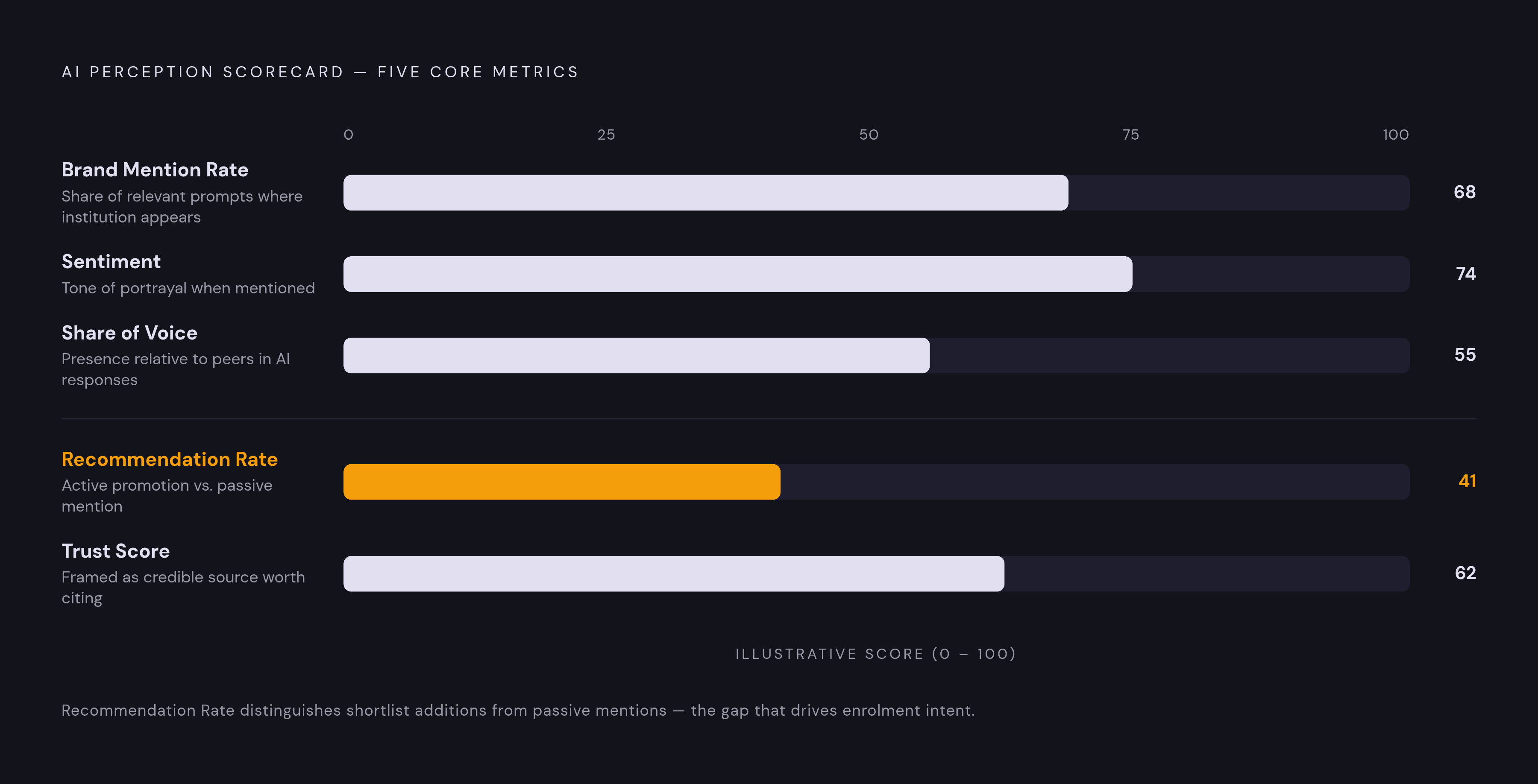
It is the systematic tracking of how AI systems represent an institution, not only whether the institution appears in a given answer, but how it is characterized, what specific claims are made about it, and whether those claims hold up as consistent and accurate across systems and over time.
A rigorous approach to this measurement rests on five core metrics that together form a structured scorecard spanning both AI and human conversation about an institution. Brand Mention Rate tracks the share of relevant prompts in which the institution appears at all in AI-generated answers. A sentiment measure captures the tone of the institution's portrayal when it does appear. Share of voice measures the institution's presence in AI-generated category responses relative to its peers. Recommendation rate tracks how often an AI system actively puts the institution forward when a student asks for options, rather than simply mentioning it in passing. Trust score, a metric used by ListenLabs.ai in 2026, measures the degree to which AI systems frame the institution as a credible source worth citing, and together these dimensions cover all three evaluative lenses that now shape a prospective student's decision: what AI systems say about an institution, what algorithmic search surfaces about it, and what human audiences, students, parents, and counselors, find when they go looking to verify a claim an AI system has made.
This kind of measurement is no longer theoretical. Peec AI, based in Berlin, launched a "brand perception" product in September 2026 that shows organizations how AI models describe, compare, and characterize their brands, including the specific points where an AI-generated claim conflicts with a fact the company itself supplies, a direct answer to the measurement gap described earlier. Evident, at evident.so, scores institutions across a wide range of signals spanning the same three evaluation dimensions, algorithmic, AI-generated, and human, giving enrollment and marketing teams a single structured view of how their institution is perceived across every lens that now shapes a student's decision, along with a sense of which gaps to close first.
The signals that determine whether an institution earns AI citations or gets passed over
Once an institution can see how it is being represented, the next question is what to do about it, and that work falls under what practitioners call Generative Engine Optimization, or GEO: the practice of shaping content so that it can be retrieved, correctly understood, and incorporated into the answers produced by AI search engines including ChatGPT, Perplexity, Google AI Overviews, Gemini, and Claude. Structured data sits at the center of this work on the technical side. It reduces ambiguity during the retrieval process, so an AI system recognizes more accurately what entity it is dealing with, and it helps the system segment and quote information correctly rather than guess at it. The relationship between search rank and AI citation is weaker than most institutions assume: recent analysis shows only roughly a third of AI Overview citations are drawn from pages that rank in the top ten of conventional search results, which means a page ranking lower can still earn AI citations if it carries strong expertise and trust signals along with solid structured data, and an institution betting its AI visibility on its search rank alone is working from the wrong assumption.
Program pages carry the highest stakes in this equation and are, in practice, the most commonly neglected. Thin content, missing Schema markup, and the absence of outcome data are the most frequent reasons a program page loses AI visibility to third-party aggregators that have filled in the gaps an institution left open. Whether an AI system can represent an institution's program offerings accurately when a prospective student asks a conversational question about them depends on what the institution actually puts on those pages. Off-site credibility signals, press coverage, faculty mentions, third-party citations, function the same way here as they did in the earlier discussion of how models evaluate authority: they are citation signals for AI systems, not simply backlinks. SEO and PR teams need a shared understanding of how earned media shapes AI-generated representations of the institution. Human trust signals, faculty expertise, outcome data, accreditation status, only carry weight in AI outputs if they are surfaced in machine-readable form. If information exists only in visually designed pages, it is structurally invisible to the retrieval systems that feed AI-generated answers.
What Regis University's AI visibility results show
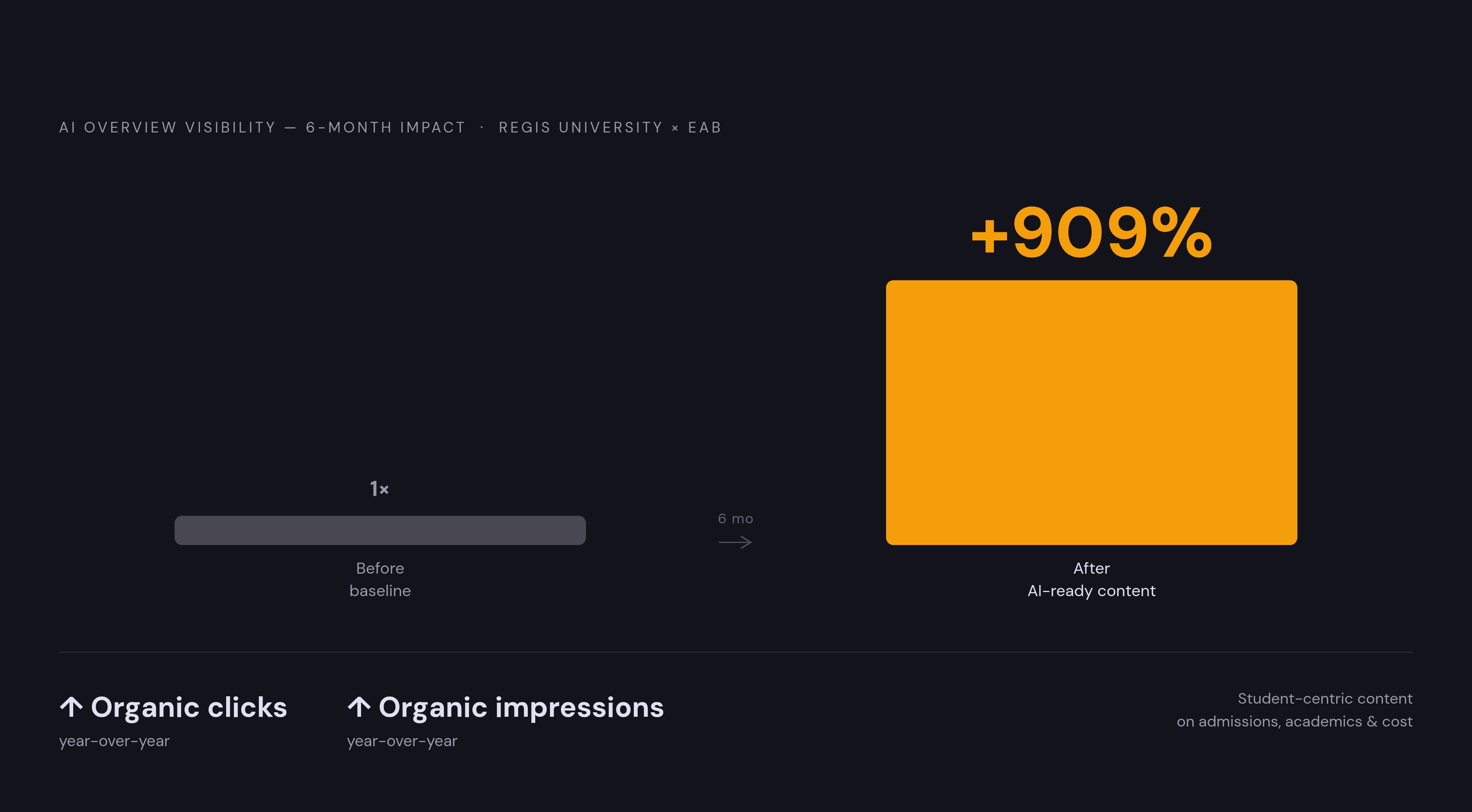
Regis University, a small Jesuit Catholic institution competing in Colorado's crowded higher education market, confronted a version of this problem that will be familiar to most enrollment offices: limited staff capacity, competing priorities across campus, and a discovery environment being reshaped by AI faster than the institution's existing online strategy could keep pace with. Regis partnered with EAB's Digital Agency to build a student-centric, AI-ready content strategy for its.edu site, concentrating the work on the pages that matter most to recruitment, admissions, academics, and cost, with content organized clearly and written in the language students actually use when they search.
The results arrived within six months. Per the EAB case study, Regis saw a 909% increase in Google AI Overview visibility, alongside a large year-over-year gain in organic search clicks and a substantial increase in organic search impressions. The case illustrates a principle that matters well beyond one Jesuit university in Colorado: the institutions that benefit most from acting early on AI visibility are not necessarily the largest or the best-funded. They are the ones willing to measure what is actually happening and act on what the measurement shows.
How enrollment and marketing teams should sequence the work
The temptation, once an institution recognizes the scale of the problem, is to optimize everywhere at once, rewriting program pages, chasing press mentions, and adding structured data without first understanding where the institution actually stands. The better sequence runs the other way: establish a scored baseline across all three evaluative lenses, AI-generated, algorithmic, and human, and then act on the gaps that most directly threaten enrollment outcomes. That baseline depends on answering a specific set of questions before any optimization work begins. An institution needs to know how often it appears in AI-generated answers to the questions prospective students are actually asking, what claims different AI systems make about it and whether those claims conflict with each other or with the facts the institution itself would supply, and which of its program pages lack the structured data, outcome evidence, or trust signals that an AI system needs before it will cite them at all.
Measurement alone is not enough without prioritization. Knowing that a given program page has thin content matters less than knowing that page is the one most likely to be queried by an AI system in a high-intent search scenario, a distinction that requires cross-signal scoring to surface rather than guesswork. Smaller and under-resourced institutions carry the most exposure to this gap, since they have the least capacity to monitor it manually, but they also stand to gain the most from closing it: being represented accurately and favorably in an AI-generated answer is a form of reach that costs nothing in advertising spend. Evident, at evident.so, is built around this exact sequence. It scores institutions across a wide range of signals, surfaces the gaps carrying the highest enrollment relevance first, and provides an ongoing read on how AI systems, algorithms, and human audiences perceive the institution over time, so that an institution catches a shift in model behavior or a competitor's gain in positioning in that ongoing read, long before it appears as a shortfall in an enrollment report. The institutions that build this measurement practice now are the ones that will see the next shift coming rather than explain it after the fact.
Sources
- 5 Predictions on How AI Will Shape Higher Ed in 2026
- AI in Higher Education: What the 2025 Survey Data Shows
- [2606.25787] How Large Language Models Source Brand Reputation Across Languages and Markets
- AI Tools Are Driving Prospective Student Decisions, UPCEA and Search Influence Research Shows - UPCEA
- New Research: AI Answers Decide Which Schools Prospects Choose
- AI visibility is critical when competing for student enrollments | EAB
- How Large Language Models Source Brand Reputation Across Languages and Markets
- From Novelty to Normalisation: Tracking Changing Perceptions of AI in Higher Education, 2024-2026