Healthcare Practice AI Discoverability and Patient Trust Signal Priorities
AI systems now decide which practices patients find before patients ever visit a website.

A practice is now evaluated by an algorithm before it is ever evaluated by a patient. You meet that evaluation through Google AI Overviews, ChatGPT, and other conversational interfaces, and Healthcare Success's 2026 healthcare marketing predictions say these are set to dominate early-stage patient research. Patients no longer move from site to site piecing together an answer. They receive a synthesized answer first, and only then decide whether a given practice is worth a visit, a call, or a click.
This matters because the evaluator at that first stage is not a person. An AI system does not read a homepage headline, does not respond to a reassuring tagline, and does not form an impression the way a human visitor does. It works through a set of structured authority signals, and it checks whether a practice's information is clear, consistent, and verifiable enough to be worth citing. A regional health system can technically rank for cardiology services under conventional SEO, but if the AI system cannot tell which locations offer which services, who the clinicians are, or how a patient actually gets access, the system stays invisible inside AI-generated answers even as its traditional metrics look fine. Ranking and recommendation are no longer the same accomplishment.
The behavioral evidence backs this up. In Wheelhouse DMG's 2026 survey of 1,099 Americans, a meaningful share said they now use AI weekly to find health information, and traditional search use is softening at the same time. That shows where patient behavior already sits, not a forecast about where things are headed, so the practices still treating AI discovery as a future consideration are already behind the patients they're trying to reach.
Why AI evaluation criteria differ from practice optimization
Most practices are optimizing for a system that is being replaced by a different one, and the signals that move AI recommendation are largely not the signals most marketing teams are managing day to day. So a practice can invest heavily in conventional healthcare SEO and content production and still miss the layer where AI systems make their citation decisions.
AI systems weigh brand mentions and branded search activity, clear and structured answers (which the research brief's citation analysis found receive substantially more citations from AI systems), domain authority, third-party corroboration, and consistency of a practice's identity across sources. They largely ignore keyword density, traditional ranking position, sheer content volume, and paid placement, all of which have anchored healthcare marketing budgets for years.
The gap is operational rather than theoretical. Two practices can publish near-identical orthopedic content, yet produce different outcomes in AI systems depending on whether named clinicians, credentials, and review dates appear on the page: the version without them consistently loses out to the version with them. A line like "our board-certified surgeons provide excellent care" reads as a credibility claim to a human visitor, but an AI system evaluates it differently depending on whether those surgeons are named, their credentials linked, and their outcomes corroborated elsewhere. Unverified language does not satisfy a system built to check.
Consistency compounds the problem. Healthcare organizations typically manage listings across dozens of digital platforms per location, and inconsistencies across those listings rank among the top problems that hurt local visibility going into 2026. A multi-hospital system that lists "Urgent Care," "Immediate Care," and "Walk-In Clinic" interchangeably across its own properties assumes a human reader will understand these as the same thing. An AI system often does not make that inference, and the inconsistency becomes a visibility problem rather than a cosmetic one. If you know which signals actually move AI evaluation, you can redirect effort toward what the evaluator is actually checking.
What empirical research shows moves AI recommendation for physicians
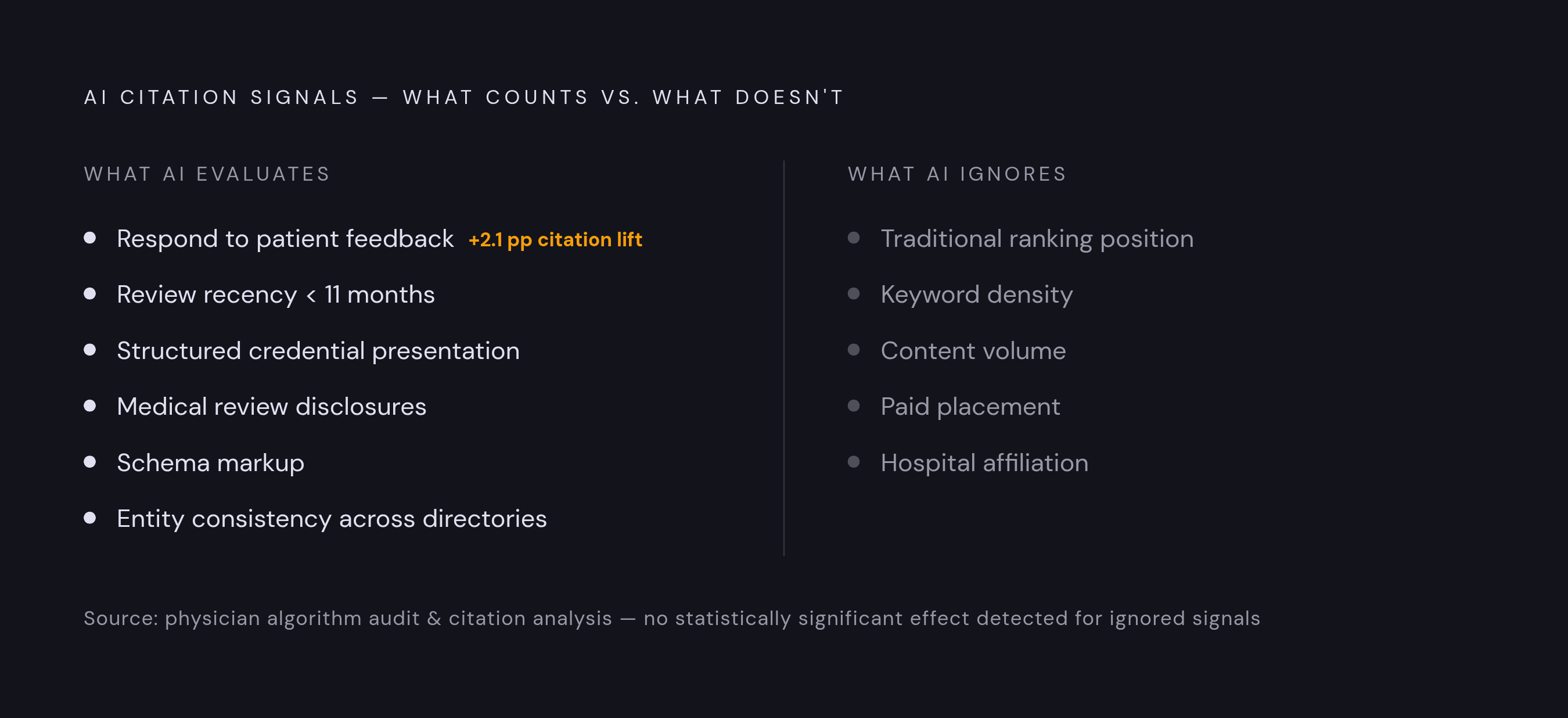
The clearest evidence on what shifts AI recommendation for physicians comes from a preregistered algorithm audit, and some of its findings cut against common assumptions about where authority comes from. This research treats large language model assistants as "AI infomediaries" that intermediate patient choice among physicians, deciding, at scale and without much visibility into the process, which providers surface and which do not.
Three signals measurably increased the likelihood of recommendation in that audit. Reviews less than 11 months old added a meaningful probability lift, responding to patient feedback added 2.1 percentage points of AI citation likelihood, and structured credential presentation moved recommendation probability as well. These are specific, checkable things a practice can act on this quarter: how recent its reviews are, whether its staff responds to them, and whether its credentials are presented in a structured, machine-readable way rather than buried in prose.
Hospital affiliation showed no statistically significant effect on AI recommendation. Many health systems built their marketing on affiliation with a known hospital brand as shorthand for legitimacy, but this finding cuts against that instinct. The audit suggests AI systems are not reading that shorthand the way patients might.
A parallel pattern appears on the citation side: commercial health information platforms that AI systems actually cite implement medical review disclosures, schema markup, and comprehensive content at much higher rates than institutional sources do, so structured credibility signals outweigh institutional prestige in how these systems choose what to cite. Professional practice websites did hold one measurable advantage: a higher share of their content was dated within the last two years, and recency turned out to be a differentiator worth tracking in its own right.
How patient trust evaluation overlaps with AI signals
Patients and AI systems do not evaluate a practice on entirely separate tracks, but they do not weigh the same signals the same way either, and the overlap is what determines which investments pay off for both audiences at once. A JAMA Network Open survey study of 3,000 US adults, conducted in March 2026, found patients were significantly more likely to trust and choose medical AI, and by extension practices associated with credible AI signals, in scenarios featuring better AI performance, FDA approval, national certification, local certification, the presence of a clinician, and the use of representative data.
Named clinician credentials sit at the center of the overlap. AI systems favor structured credential presentation as an authority signal, but patients favor the presence of a real, identifiable clinician as a trust anchor. Third-party validation is a trust signal shared by patients and AI systems, though each weights it differently.
The divergence appears in how each evaluator treats access and scrutiny. Patients respond to access signals, such as online scheduling availability and clear next-step guidance, but AI systems don't register these as credibility markers at all. Healthcare Success notes that most consumers rank online scheduling availability as extremely or very important when they choose a provider, yet this signal carries no weight in AI evaluation. Patients also apply more scrutiny to AI-generated information when it comes from search than when it comes from an AI tool directly, verifying search results more often than they verify AI tool output. That asymmetry raises the stakes for accuracy in AI-presented practice information, because patients are least likely to double-check the exact channel most likely to shape their first impression. Broader research backs this up at the level of behavior: how much patients trust the source of their health information strongly shapes how they interpret it and whether they act on it, including whether they seek care at all, a pattern documented in the Health Information National Trends Survey and cited in Healthcare Success's 2026 predictions. The signals that satisfy both evaluators at once are the highest-priority investments a practice can make.
The structured signals that serve both AI systems and patient trust simultaneously
A specific set of structured signals clears the bar for AI evaluation and patient trust at the same time, and that overlap is where a practice should start.
Named physician profiles, built out with board certifications, years of experience, affiliated institutions, and peer-reviewed publications or media appearances, give AI systems the structured authority they check for and give patients the human trust anchor they look for. Medical review disclosures paired with clear content dating consistently outperform anonymous, undated content in both AI citation rates and patient engagement, and the commercial health platforms AI systems actually cite implement these disclosures at high rates. Schema markup and structured data let AI systems extract clean answers from a page at measurably higher rates, a technical input that directly affects whether a practice shows up in an AI-generated response.
Responding to patient feedback does double duty: the algorithm audit found it adds measurable probability lift to AI recommendation, and for a human reader, a practice that responds to feedback looks engaged and accountable. Entity consistency across directories works the same way. A practice listed identically, in service names, locations, and credentials, across Google Business Profile, Apple Maps, and healthcare-specific directories reads as a coherent, trustworthy entity to both AI systems and search infrastructure.
Google's E-E-A-T framework, Experience, Expertise, Authoritativeness, and Trustworthiness, organizes most of this into a single checklist, since the criteria Google uses to judge content quality largely overlap with the criteria AI engines use when choosing what to cite. A practice that builds toward E-E-A-T deliberately is building toward both audiences without having to run two separate playbooks.
Where AI and patient signals diverge
Not all signals serve both audiences equally, and a practice that treats AI optimization and patient trust as identical ends up investing in the wrong place at the margin. Hospital affiliation illustrates the split clearly: patients may still weight it as a trust signal, but the empirical audit found no statistically significant effect on AI recommendation, meaning that investment pays off in human trust without moving AI visibility at all.
Patient access signals, online scheduling, frictionless intake, clear next-step guidance, convert patients who have already found the practice, while AI relies on different signals entirely to decide whether to surface that practice in the first place. That's a conversion-layer problem, not a discoverability problem, and the two call for different fixes. Content depth works in a similarly split way: commercial health platforms cited by AI implement comprehensive content at higher rates, but volume alone drives AI citation rather than patient engagement, and a long page that isn't structured for direct-answer extraction can end up serving neither audience.
Accuracy is the signal where the stakes run highest. A high mention rate in AI outputs can mask a serious problem if the AI is presenting outdated locations, incorrect services, or inaccurate credentials, and in healthcare, accuracy can matter more than raw visibility given that patients make care decisions based on what gets synthesized. FDA approval and national certification round out the divergent category: the JAMA Network Open study found these factors significantly moved patient trust in medical AI scenarios, and they carry potential AI-citation authority too, but they require formal institutional action rather than a content update.
The practical approach follows from this split. Start with the convergent signals, named credentials, structured data, review responsiveness, entity consistency, since those move both audiences at once. Then decide on the divergent signals based on which specific gap a practice is trying to close: a discoverability gap calls for different investment than a conversion gap.
Measuring AI Perception Separately from Traditional Metrics
Organic traffic, ranking position, and star ratings cannot tell a practice whether AI systems are representing it accurately, and that blind spot is now a distinct, consequential failure mode on its own. A practice can lose a meaningful share of informational SEO traffic without losing revenue, but only if it is still cited inside the AI layer that's now absorbing that early-stage search volume. Going into 2026, informational query traffic declines while branded and low-funnel query traffic holds steady or grows. If the traffic a practice is losing was always early-stage browsing, and AI is now handling that synthesis on the practice's behalf, the traffic loss does not translate into lost patients.
The inverse risk carries just as much weight and gets noticed far less often. A practice can have stable, healthy organic traffic and still get inaccurate or absent representation in AI outputs, so it quietly loses influence over early-stage patient decisions even as every traditional metric it tracks looks fine. Traditional attribution models assume influence happens at the click, but when an AI system synthesizes information from multiple sources before a user clicks anything, last-touch attribution misses the moment the decision was actually shaped. A patient can start in search, validate through an AI tool, and convert on the practice's official site, and that journey is one no single-channel metric can reconstruct.
What's emerging in response is a distinction between a practice being "mentioned" and being "understood" by AI systems. That distinction breaks down into separate, checkable questions: whether a practice's information was available to the AI system at all, whether it was retrieved, whether the source was cited, whether the information was materially used in the answer, whether the brand was named, how prominently, whether the representation was accurate, and whether the portrayal read as favorable, neutral, or negative. For healthcare specifically, accuracy carries more weight than visibility, because an AI system presenting outdated locations, discontinued services, or incorrect credentials creates a patient trust failure that no star rating will ever surface. A practice cannot manage what it cannot observe, and none of the metrics most practices already track are built to observe this.
What a working signal monitoring system covers
Effective monitoring for a healthcare practice has to track three distinct dimensions at once: AI citation and representation, algorithmic credibility signals, and human trust indicators. A gap in any one of these creates a blind spot that the other two cannot reveal on their own.
AI citation and representation covers whether a practice is being retrieved and cited by AI systems at all, how it's being described when it is, and whether that description is accurate: correct locations, correct services, correct clinician names and credentials, rather than a stale or garbled version of the practice's actual identity. Algorithmic credibility signals cover the structured inputs this piece has walked through: review recency, response rate to patient feedback, schema markup, medical review disclosures, and entity consistency across every directory and listing a practice maintains. Human trust indicators cover the signals patients respond to directly, named clinicians, certification, access and scheduling clarity, and the broader sense of whether a practice's online presence matches the experience a patient actually gets once they walk in.
A practice that tracks only the third dimension, the one most familiar to traditional healthcare marketing, is flying blind on the first two, exactly the dimensions where AI systems are making silent decisions about who gets surfaced and who doesn't. Effective signal monitoring requires tracking across all three dimensions, because a gap in any one creates a blind spot the other two cannot reveal.