AI Discoverability Signals for Higher Education Institutions
Universities must optimize for AI discovery before students even reach their websites.
A prospective student now types a question into ChatGPT, gets an answer, and may never click through to a university website at all. That sequence, repeated across hundreds of thousands of searches a month, is the reason AI discoverability has become a concrete operational problem for higher education institutions rather than a future one.
How students now find programs before reaching a university website
A growing share of prospective students now encounter AI-generated program summaries before they visit an institution's site at all. A chatbot answer increasingly forms the first impression of a program, ahead of the program page itself. A 2025 study from UPCEA and Search Influence found that 79% of prospective students read Google AI Overviews, and roughly half use tools like ChatGPT and Gemini on a weekly basis. That means the orientation phase of a student's decision journey, the part where options get narrowed and first impressions form, has largely moved outside institutional control. A SparkToro analysis of Similarweb clickstream data found that most U.S. Google searches in the first four months of the year ended without a click. Programs are now competing for presence inside an answer rather than for position on a results page.
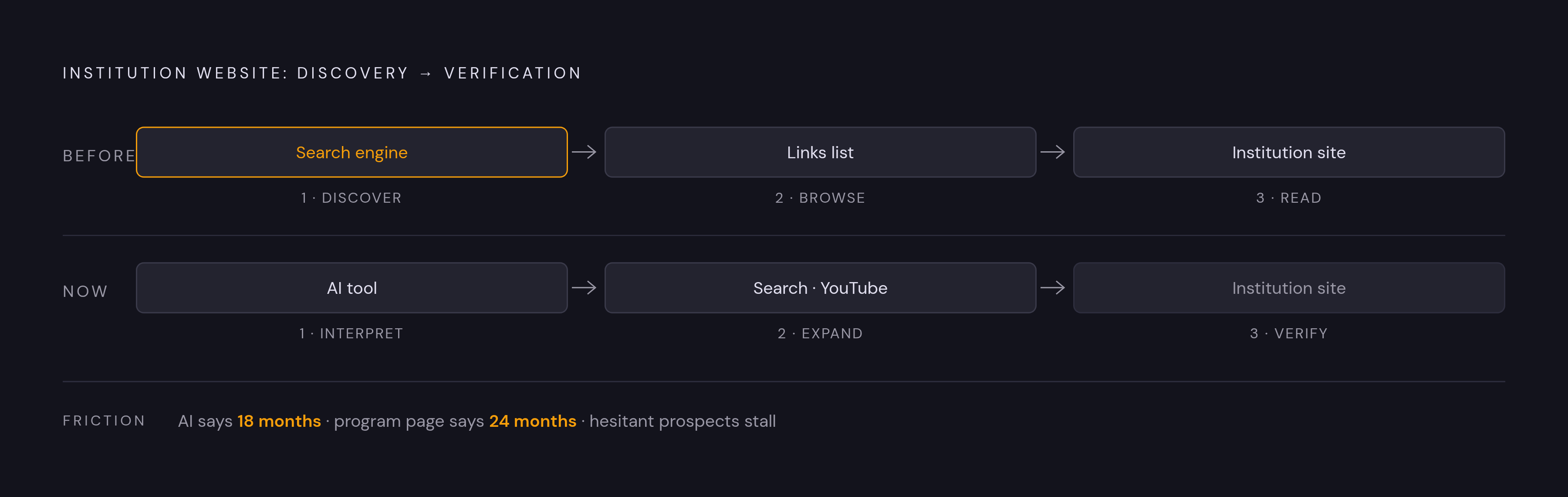
The research sequence itself has flipped. Where students once started with a search engine and narrowed down through a list of links, AI tools now provide the first interpretive pass, traditional search and YouTube serve to expand the set of options, and the institution's own website functions as a verification step rather than a discovery step. But when the institution's site disagrees with the AI's summary, that changed order causes real friction. Search Influence points to a simple example: an AI answer states that an MBA takes 18 months, while the program page itself says 24. A discrepancy like that does not convert a hesitant prospect, it stalls them.
Why AI Systems Favor Some Institutions
AI systems do not read an institution's public footprint neutrally, and understanding the bias built into that reading is the starting point for doing anything about it. Peer-reviewed research has found that large language models heavily overrepresent elite universities relative to their actual share of enrollment, and this is a documented structural feature of how these systems rank institutions, not a passing quirk. That pattern puts most institutions at a disadvantage by default, so building deliberate, countervailing signals matters more than treating AI visibility as something that sorts itself out over time.
The same body of research offers a more useful finding: the effect of journal prestige on how an LLM scores an institution substantially outweighs the effect of institutional prestige itself. In practice, this means a university's faculty publication record functions as a direct, measurable input into how AI systems rate the institution as a whole. Elite status is not a closed door. Research output, published in the right venues, moves the needle for any institution willing to build it out.
The citation source mix behind these rankings tells a parallel story. A typical institution draws most of its AI citations from its own domain, while top-performing institutions draw a much smaller share of their citations from their own site and rely instead on third-party sources. Self-published content, no matter how well it is written, is not enough on its own to produce strong AI representation. AI perception lags content publication by months, so the associations forming in AI answers today reflect an institution's public footprint from earlier in the year, which makes early, sustained signal-building far more valuable than reactive fixes applied after a gap is discovered.
The three signal layers that determine whether a program appears in AI-generated answers
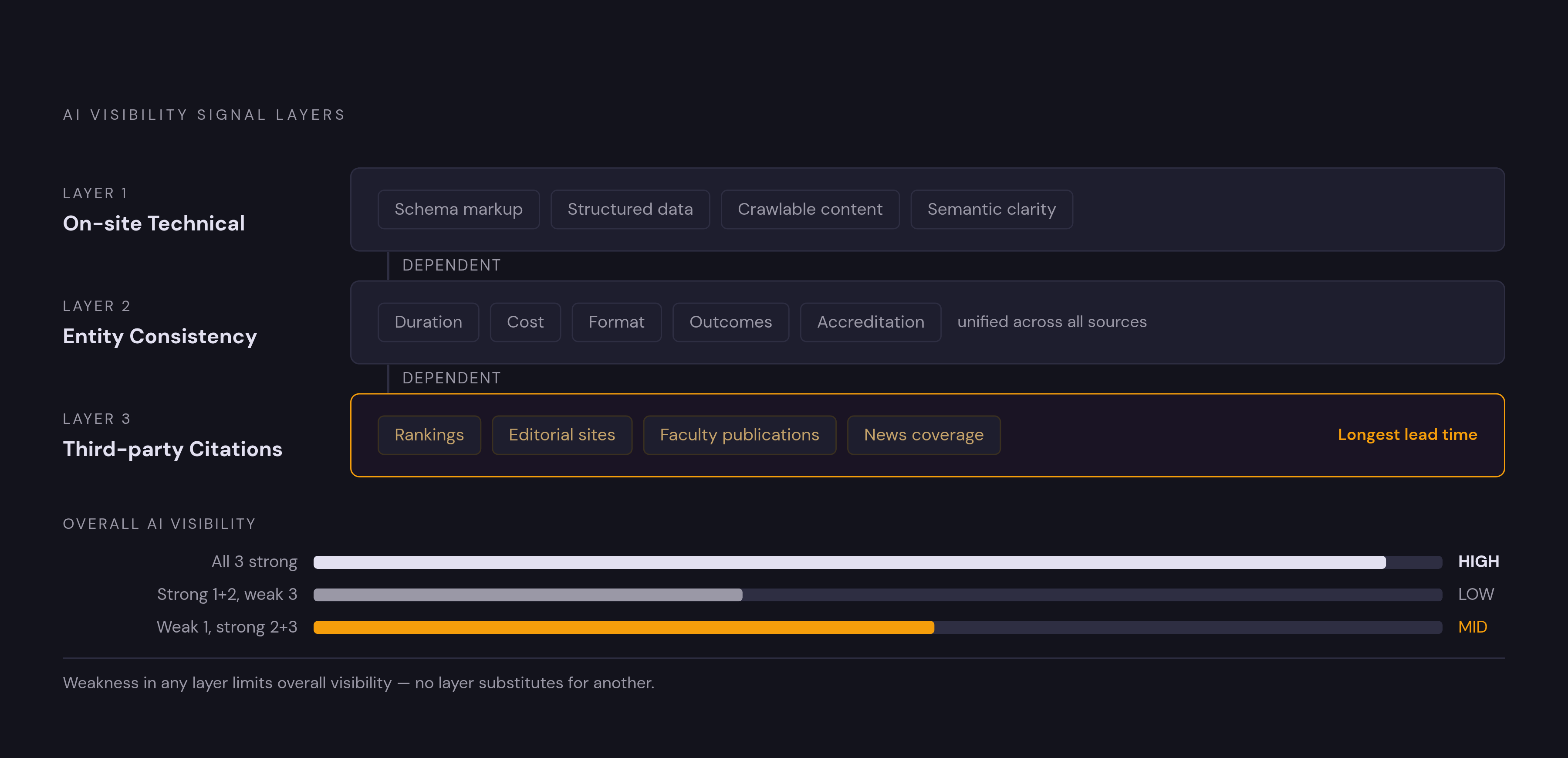
The three signal layers are interdependent, and weakness in any one limits overall visibility regardless of how well the others are optimized.
The first layer is on-site technical signals. Schema markup and structured data let AI systems understand not just what a program page says in prose, but how that program connects to its department, its faculty, its cost, its format, and its outcomes. 2U's analysis describes structured data as a "universal translator," moving an institution's content beyond keyword matching and establishing expertise, domain authority, and relationship context for the AI systems parsing it. If a page stays semantically clear and focused on the actual questions students ask, it surfaces more reliably in AI answers than dense catalog-style copy, so write it to answer who a program serves, what skills it builds, and what outcomes it produces. Crawlable content is the prerequisite for any of this to matter. Technical accessibility is the prerequisite every other signal depends on.
The second layer is entity consistency across sources. AI systems weigh how consistent an institution's program pages, rankings appearances, salary data sources, and public discussions are with one another, and inconsistent signals produce weaker or inaccurate representations in generated answers. Search Influence treats this as an ongoing operational requirement, not a one-time project: institutions have to unify program data, structure pages for AI readability, reinforce entity signals, and maintain data hygiene continuously.
The third layer is third-party citation signals, the web consensus an institution sits inside. AI platforms draw on rankings, editorial sites, listicles, forums, and news coverage when generating answers, so institutional representation depends heavily on what those external sources say. Faculty expertise distributed through academic publishers and professional platforms feeds directly into the knowledge graph AI tools draw from, making thought leadership a discoverability input rather than a branding exercise.
What program-level visibility gaps look like in practice
Visibility gaps are program-specific, not institution-wide. A university can have strong AI representation for one department while a neighboring program at the same institution is effectively invisible, and an aggregate institutional metric will not reveal this unevenness at all.
A Manaferra analysis of Western Washington University shows exactly this pattern. Its Business program showed up in only a minority of tested AI queries, and ChatGPT recommended the University of Washington's Foster School of Business and Washington State University's Carson College of Business instead. Its Computer Science program fared worse still: it appeared in even fewer of the tested queries. The comparison shows how much competition and visibility can shift from one program within a single university to the next.
The consequences of closing that gap are measurable. 2U reports that when partner programs put AI-discovery practices in place, their mentions in AI-generated summaries doubled, and traffic arriving through ChatGPT converts at twice the rate of traffic from other organic sources. Students arriving through an AI answer tend to be further along in their decision-making already, so a visibility gap is a conversion-rate gap as well.
The student-side stakes are severe. Search Influence's statistics compilation found that a majority of undergraduates said they considered a school less when it did not appear in their AI search results, a share that rose sharply from the year before. Absence from AI results can remove an institution from a student's shortlist before that student ever reaches the institution's own website. UPCEA and Search Influence's 2025 survey found a trust effect compounds this further: 56% of students report being more likely to trust a brand that AI cites. Institutions already showing up in AI answers gain reinforcing credibility when students go on to verify that answer on the university's own site, which widens the gap for institutions that never appeared in the first place.
Why most institutions cannot yet see these gaps
Institutional readiness for AI search lags well behind student behavior, and the main barrier is the absence of systems built to monitor and measure AI representation. The UPCEA and Search Influence Snap Poll found that 60% of institutions describe themselves as still in the early stages of exploring AI search, fewer than a third report having a formal AI search strategy in place, and a small share have either not started or do not believe AI search will meaningfully affect student discovery.
Agencies working with these institutions show a similar pattern. Most show awareness of AI search through the educational content they publish, but you rarely find documented implementation frameworks, working AI visibility tracking systems, or technical GEO methodologies in publicly available practice. Understanding that AI search matters is now widespread. Knowing how to measure an institution's standing within it is not, and that gap is the dominant differentiator between institutions making progress and those standing still.
The Tambellini Group's trend analysis frames this as a visibility metric problem: institutions need to rethink measurement well beyond clicks, traffic, and rankings, because those traditional indicators do not capture whether or how an institution is represented in AI-generated answers. On top of that, AI perception of the same institution can vary substantially across different AI systems, a finding from the AI Perception Index 2026. Strong visibility in one AI environment carries no guarantee of accurate representation in another. A high mention count can also hide a positioning problem: an institution may appear frequently in AI answers while being described in terms that are inaccurate, outdated, or misaligned with its strongest programs, a failure mode that click-based measurement tools simply cannot see.
Measuring AI discoverability before improving it
An institution that cannot score its own AI discoverability across the three signal layers has no real basis for deciding which gaps to close first, which makes measurement the step that has to come before optimization, not after it.
Practitioner frameworks for AI brand perception monitoring apply a five-metric evaluation across share of voice (how often an institution turns up in relevant AI answers), sentiment polarity (whether those mentions read as favorable), citation context (whether and how the institution gets cited as a source), emotional tone, and emerging themes. The baseline audit method for building this picture is structured prompt testing: submitting the same standardized queries about specific programs across ChatGPT, Gemini, and Perplexity, then recording which institutions appear, which sources get cited, and how each program gets described. This is the method behind the Western Washington University analysis cited earlier.
From there, an entity consistency audit checks whether the same program facts, duration, cost, format, outcomes, accreditation, appear the same way across an institution's own pages and across the third-party sources AI tools are most likely to pull from. A citation source audit follows, identifying where an institution's AI mentions actually originate. An institution drawing most of its citations from its own domain has a third-party signal gap, and closing that gap calls for a different set of interventions than fixing on-site structured data would.
You can find a precedent for this kind of layered measurement outside higher education. Evident benchmarks AI adoption in financial services from evidentinsights.com, and it combines manual research with automated data capture across public data sources. That cross-layer approach maps gaps at a granular level instead of collapsing everything into a single institutional score, and it is the model higher education needs to apply at the program level, where the real unevenness actually lives.
The fixes that move each signal layer
Once an institution has scored its signal gaps by layer, the order of operations follows directly from how the layers depend on one another. Technical crawlability failures block every other fix downstream, so you need to resolve them first. Entity inconsistency depresses citation accuracy across all third-party sources, so it needs to be unified before third-party signals can reinforce an accurate picture. Third-party citation building takes the longest lead time of the three and should start in parallel with the other two rather than waiting for them to finish.
On the technical layer, schema markup should explicitly define program relationships: parent department, faculty, duration, format, cost, and outcomes, so AI systems can read the structure directly instead of inferring it from prose. Academic catalog language needs translation into explicit, citable facts: who a program serves, what skills it builds, what it costs, and what its graduates go on to do, the exact content signals 2U identifies as what AI systems retrieve and surface in their answers. Crawlability itself needs auditing as a baseline check, since content an AI system cannot crawl will never appear in its answers regardless of how well it is written.
On the entity layer, the work is less a project than an ongoing discipline: unifying program data across every page where it appears, structuring those pages for AI readability, reinforcing entity signals, and maintaining data hygiene as a continuous practice rather than a one-time cleanup. On the third-party layer, the lead time is longest because it depends on faculty research landing in high-prestige journals, on press coverage, and on faculty expertise reaching academic publishers and professional platforms where AI systems' knowledge graphs can pick it up. None of these three layers substitutes for the others. An institution with excellent schema markup and no third-party citations will still underperform one with weaker technical signals and a strong footprint of outside coverage, because AI systems weigh all three together when deciding what to surface and how to describe it.
Sources
- AI Search Optimization for Graduate Education Marketing in 2026
- Higher Education AI Search Strategy: What Students Expect vs. How Institutions Must Adapt
- The New Front Door to Higher Education: How AI Is Changing Program Discovery
- How AI is reshaping higher education program discovery
- 2026 Trend Analysis: Optimizing Institutional Visibility in the AI Era - The Tambellini Group
- 10 Best AI Search Visibility Agencies for Universities in 2026
- 30+ AI Search in Higher Education Stats [2026]