Manufacturing and Industrial Brand Perception in B2B AI-Driven Procurement Research
AI now decides which manufacturers appear in buyer research before any sales conversation begins.
When a procurement manager searches for contract manufacturers, you don't start with a search engine anymore. That research is invisible in any supplier's analytics dashboard. A buyer's vendor shortlist now gets built inside AI systems before any seller hears from them, so in industrial and manufacturing B2B, AI is the front door to procurement research.
How industrial procurement research has moved inside AI engines
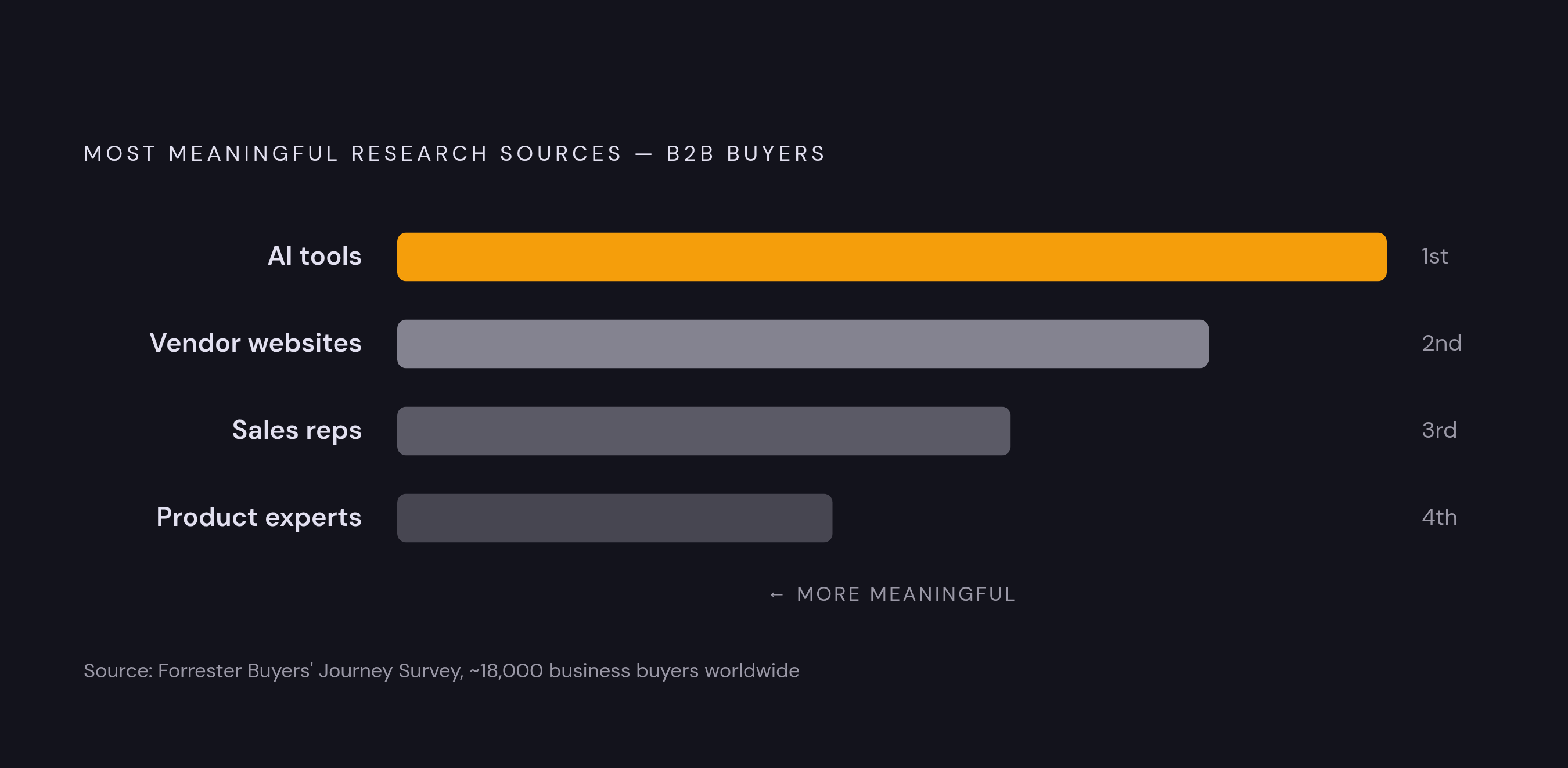
The scale of that shift is no longer marginal. Forrester's Buyers' Journey Survey, which polled nearly 18,000 business buyers worldwide, found that most B2B buyers used AI during their most recent purchase, a share that grew from the year before, and that AI tools now outrank vendor websites, sales reps, and product experts as the research source buyers consider meaningful. Buyers use AI to compare vendors, research product capabilities and specifications, and build the internal business case that justifies the shortlist to their own stakeholders, and they do all of this before any vendor contact happens. By the time a seller enters the picture, most of the evaluation work is finished, and the buyer isn't exploring options anymore so much as confirming a decision that has already started to take shape.
Industrial buyers, often assumed to be slower-moving and more skeptical than their counterparts in software or services, turn out to follow the same path. Gardner Web's coverage of the 2025 Industrial Buying Influence Survey found that buyer selection of AI Overview as a preferred search result type posted the largest single-year gain of any metric tracked across four years of that survey, and this is an engineering audience that tends to distrust marketing claims on principle. And when the shortlist forms before contact, it isn't a soft preference that sales can later overturn. 6sense's 2025 data shows that most deals are won from the Day One shortlist, the list a buyer assembles before any seller conversation, and the vendor who holds the favorite position on that list wins most of those deals. The research has already happened. What sellers usually treat as the start of the sales process is, for the buyer, closer to the end.
Why industrial buyers route their research through AI
Industrial procurement didn't adopt AI research by accident. The conditions of the industry make AI compression unusually valuable: specifications run dense and technical, comparing vendors against those specifications takes real engineering judgment, and the buying committee behind any purchase tends to be large. A single capital equipment or contract manufacturing decision can pull in distinct functions, each running its own evaluation. Engineering checks spec compliance and technical feasibility. Procurement weighs cost, contract terms, and supplier risk. Operations cares about lead time and whether supply stays continuous. Finance digs into total cost of ownership and payment terms. Quality checks certifications and defect history. Each of these stakeholders does their own AI-assisted research before the group ever sits down together, so a manufacturer has to manage several separate AI-mediated impressions across one deal, not one unified pitch delivered once.
The 2025 Industrial Buying Influence Survey adds a detail that matters for how manufacturers should think about this: most manufacturing buyers don't trust AI output at face value, but most of them verify what AI tells them against other sources, and a further share clicks through to the sources AI actually cited. AI is where the search starts even when it isn't where it ends. So when AI cites you, you don't just win an impression inside a chat window. It determines which sources a skeptical buyer goes on to check.
Supply chain diversification is pushing in the same direction. LooperBuy's analysis found that North American buyers' reliance on their top three supplier countries fell meaningfully in a single year, and that means buyers now evaluate more unfamiliar suppliers. You can't run that expanded search by hand, supplier by supplier, country by country, at the pace procurement now moves. AI is the tool buyers reach for to make that broader search efficient, and that reliance compounds the pressure on manufacturers to be visible to it.
AI Perception of an Industrial Brand
AI systems don't visit a manufacturer's website when a buyer asks a question. They draw on a synthesized picture of the brand built from scattered public signals, assembled well before the query was ever typed, and that picture decides whether the brand appears in the buyer's results. The sources behind that picture are not the ones most manufacturers have spent their budget on. Analysis of more than a million AI prompts found that most non-paid AI citations trace back to earned media, trade press, industry publications, and independent analysis, not vendor websites or owned content. A Moz study of 40,000 queries in 2026 found that most citations inside Google's AI Mode don't appear anywhere in the organic top 10 results, so a strong SEO ranking doesn't carry over into AI citation presence the way manufacturers might assume it would.
The research behind how LLMs actually evaluate suppliers has moved past theory into direct testing, and the central finding is an asymmetry that changes how manufacturers should think about their own content. A peer-reviewed study in the Journal of Business Logistics, by McKinley, Dohmen, and Castillo, found that AI stays highly consistent when scoring compliance signals, things like technical specifications, which makes it dependable for qualification screening. But when the same models score competitive signals, the value-add claims a manufacturer makes about why it's the better choice, not merely an adequate one, they show high volatility. That asymmetry carries a direct consequence for strategy: AI is good at confirming that a manufacturer clears the bar, and far less reliable at conveying what makes that manufacturer worth choosing over a competitor that also clears it. The differentiation a manufacturer spends years building, the thing sales teams are trained to lead with, is the part AI is structurally worst at representing.
Documentation quality changes this picture, but brand teams might not expect the direction it changes in. A ScienceDirect study found that when procurement-relevant context features get added to LLM ranking, retrieval performance jumps sharply, so a supplier's public documentation, if it's structured so an AI system can parse it, directly affects whether that brand gets found and ranked in the first place. Volume alone doesn't do this. Structure does. Research published in Frontiers in Artificial Intelligence Research confirms that LLMs also process less structured material, supplier capability descriptions, customer testimonials, corporate sustainability reports, folding all of it into assessments that sit alongside quantitative performance data. And this isn't a quirk of one model's training. The Journal of Business Logistics study tested o3, Grok-3-Mini, and DeepSeek-R1-0528 and found no meaningful difference in the compliance/competitive asymmetry across any of them, which marks this as a structural behavior of large language models as a category, not a bug in a single product.
Why AI ignores certain industrial brands
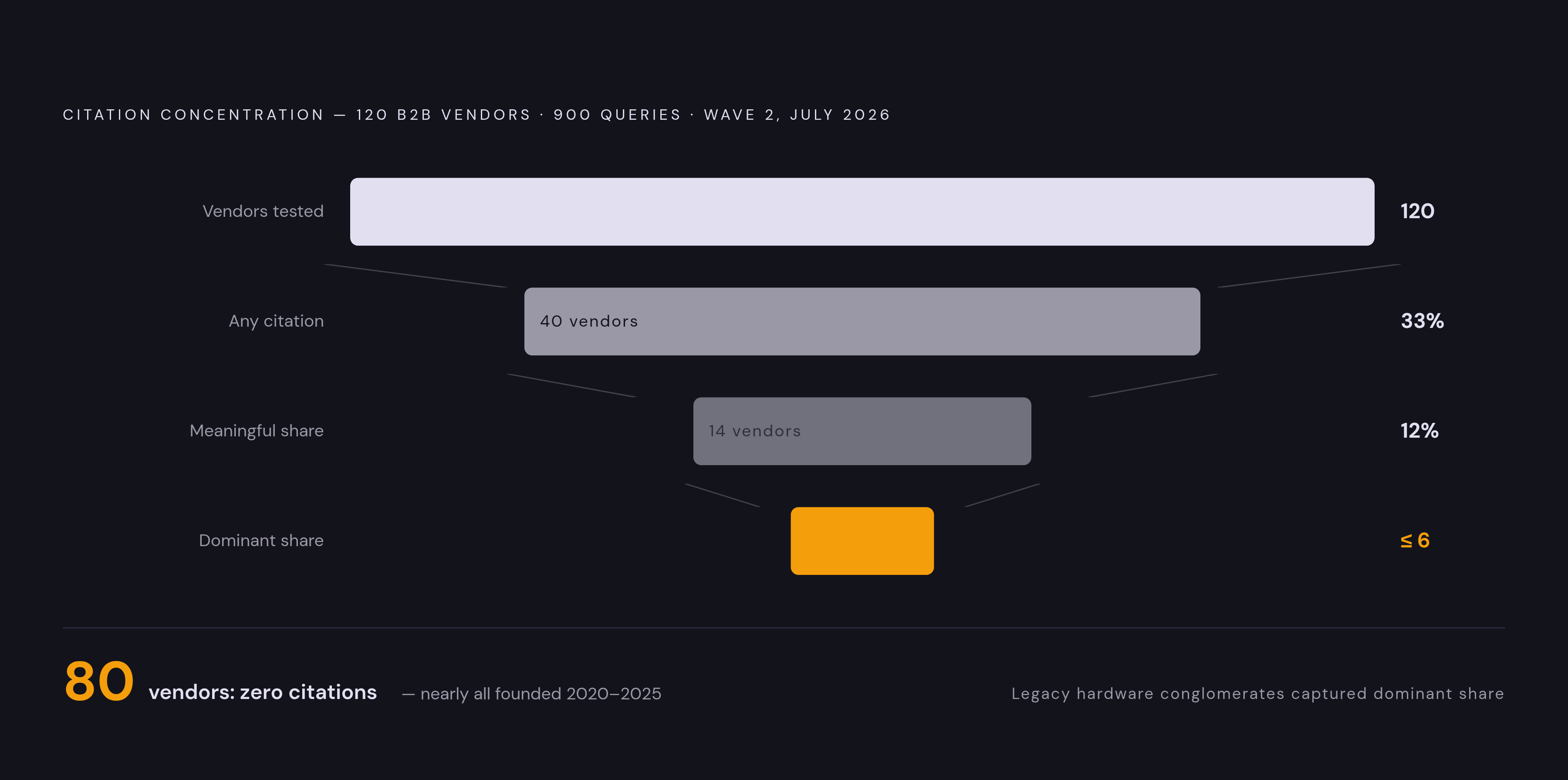
Most industrial B2B vendors get zero AI citations, and the absence isn't random. It follows from which signals AI systems can find and verify in the first place, a concentration a June 2026 peer-reviewed sourcing study on arxiv confirmed by finding that Perplexity draws from only 15,995 unique domains across all of its citations. The Algorithmic Authority Index Wave 2, published in July 2026, measured Share of Model across 120 industrial B2B vendors on ChatGPT, Perplexity, and Google AI Overview, running 900 buyer-intent queries against them. Most of the 120 vendors tested received no citations at all. Legacy hardware conglomerates captured the dominant share of model in mature industrial segments, and the absence rate climbed even higher for vendors founded between 2020 and 2025, the cohort that includes much of the industry's newer, more specialized manufacturing capacity.
The study also found that AI engines overwhelmingly return a company's old brand name after it has rebranded, so the AI-facing version of that company's identity can lag the real one by months or years. Large language models inherit this from older training data and archived web pages that never got updated once the rebrand happened. A manufacturer that invested heavily in a new name, a new visual identity, a repositioned value proposition, can find that AI tools are still introducing it to buyers under the name it retired.
A single buyer might use several AI platforms, and citation behavior shifts from one to the next. A Superlines cross-platform analysis found that citation volumes for the same brand can differ by orders of magnitude from one platform to another, and only a small share of domains get cited by both ChatGPT and Perplexity. A brand that looks well represented in one tool can be functionally invisible in the next one the same buyer opens. On top of that, procurement history itself appears to tilt the field toward incumbents: removing buyer-group history features from retrieval models hurt performance for vendors with established relationships but improved it for vendors with no prior relationship on record. AI systems, when fed procurement history, lean toward favoring the suppliers buyers have already worked with.
Why absence from AI citation is a pre-contact disqualification
Getting cited by AI isn't a visibility nicety. It functions as a trust filter that decides which brands even enter the buyer's conversation, long before a salesperson gets the chance to make a case. 6sense's research already established that most deals are won from the Day One shortlist formed before seller contact, and that the favorite on that shortlist wins most of those deals. So when an industrial brand isn't cited before first contact, it has already been disqualified from the competition.
A buyer who arrives at a supplier's website after getting that supplier's name from an AI tool has already cleared one credibility hurdle before the first page loads, which turns that initial interaction into a validation step rather than a discovery one. The commercial cost of being left out of that first filter is hard for most manufacturers to see, because the systems built to measure marketing performance weren't built for this. Forrester's data shows B2B companies already reporting meaningful declines in website traffic as research shifts into AI engines, and most of the B2B buying journey now runs through channels that leave no trackable signal behind. Attribution models built around site visits and form fills can't measure a loss when it happens inside someone else's chat interface.
Absence isn't the only failure mode, either. Harvard Business Review found that LLM data about brands is frequently incomplete or wrong. A brand that does get cited but gets described inaccurately faces a problem just as serious as not being cited at all, and arguably harder to fix, since there's no early moment in that buyer's journey where a human conversation could correct the record.
What signals determine whether AI cites an industrial brand
The signals that drive AI citation of industrial brands are fundamentally different from the signals that drive traditional search rankings, and manufacturers optimizing for one are not automatically building the other. An Ahrefs study of 75,000 brands found that web mentions of a brand correlate far more strongly with AI visibility than backlinks do, a real break from traditional SEO, where link authority has carried the most weight for years. A Fullintel-UConn academic study, presented at the International Public Relations Research Conference, found that most links cited by AI engines trace back to earned media coverage, and not to owned or paid placements. For an industrial buyer specifically, a technical feature in a manufacturing trade journal carries more weight with AI citation than a large volume of star ratings on a review site.
Structure matters as much as placement. Gardner Web's 2026 guidance points to application case studies, technical process guides, and product performance data published on well-trafficked trade media sites as the content that tends to surface in AI-assisted search, provided it's built with headlines, bullet points, tables, and clear definitions that an AI model can actually parse. Volume of content without that structure doesn't do the same work.
Context shapes perception too, not just content. Who a brand gets mentioned alongside affects how AI categorizes and positions it, and if the pairing is negative, that carries real downside for how the brand gets framed in response to a buyer's query. When AI runs into conflicting descriptions of what a company does and who it serves, it tends to produce a flattened or averaged characterization rather than an accurate one, a separate signal from the ones above but produced by the same averaging mechanism that causes AI engines to keep citing a company's retired name after it rebrands, as the Algorithmic Authority Index documented. Not every mention counts equally, either. The tier of the publication doing the citing, multiplied by the sentiment of that coverage, determines how much any single citation contributes to the AI's overall perception of the brand. And presence has to be spread across more than one channel to register as real authority: trade media, industry associations, supplier directories, exhibitor lists at trade shows all feed into how AI systems infer which companies are established in a category, and a brand with strong presence in only one of those channels is working from a thin signal base no matter how good that one channel's content is.
Sources
- Industrial Market Research Company: Why Global Buyers Are Rewriting Their Sourcing Playbooks in 2026 - LooperBuy
- How AI Changed the B2B Buying Process in 2026
- 94% of B2B Buyers Use AI for Vendor...
- Buyers Are Turning to AI for Product Research. Does Your Marketing Put Your Brand in the Right Place?
- A governed framework combining large language models and human oversight for supplier selection - ScienceDirect