Financial Services Brand Trust Signals That AI Systems Prioritize
AI systems now decide which financial brands deserve mentions, reshaping how discovery works.

A customer asking "which lender should I trust" or "who are the leading wealth managers" no longer lands on a search results page full of links to click through. ChatGPT, Perplexity, Gemini, and comparable systems now answer the question directly, naming (or failing to name) specific firms as part of the response itself. That shift changes what discovery means for a financial brand: the first encounter a prospective customer has with a bank, lender, or advisory firm increasingly happens inside an AI-generated answer, not on the brand's own website. If the brand is absent from that answer, the brand has no way of knowing it happened unless someone is explicitly measuring for it.
This reframes the central question financial marketers have to ask. Ranking for a keyword used to be the goal; now the goal is being the name an AI model produces when a category question comes up. eMarketer's AI Visibility Index for financial services tracked ChatGPT brand mentions across the sector in the second quarter of 2026 and found Capital One named in 19% of financial services recommendations that June, more often than any other brand measured. That figure matters less as a ranking than as proof that AI-driven brand presence in finance is already uneven and already quantifiable.
The sector's own regulatory weight raises the stakes further. Finance operates under strict trust and disclosure standards, so systems built to handle financial queries get trained toward accuracy and credibility, and that narrows which brands qualify for citation at all. A joint report from ESMA, the Institut Louis Bachelier, and the Alan Turing Institute on large language models in finance notes that these systems are increasingly used for public communication and direct customer interaction, which raises reputational stakes that did not exist when AI tools stayed confined to internal, back-office use. Yet most financial marketing budgets and attention remain fixed on the older surface: search rankings, website design, paid placement. Understanding why that layer behaves the way it does starts with understanding how these systems actually read and weigh the content in front of them.
How LLMs Read Financial Content
Large language models don't treat every piece of content equally, and in finance the selectivity is sharper than almost anywhere else. A hallucinated fact about a mortgage rate or a fiduciary obligation carries legal exposure and reputational cost that a hallucinated fact about, say, a restaurant recommendation does not. Domain-specific evaluation of LLMs exists precisely because general capability benchmarks don't capture how reliable a model is within a specialized field, and the Jilin University survey of LLM evaluation methods treats this as a foundational reason finance needs its own testing standards rather than borrowed ones.
That caution shapes which brands actually surface in an answer, even when the model has technically encountered their content somewhere in training or retrieval. Practitioners describe this filter as "Entity Authority": if a model doesn't recognize a brand as a credible, established player within its specific niche, it can simply leave that brand out of the synthesized answer, regardless of how much content the brand has published. Being findable and being trustworthy enough to cite are two different thresholds, and only the second one determines inclusion.
FinTrust, a benchmark built by researchers at NYU Shanghai, NUS, and Yale, illustrates how layered this trust evaluation has become. It assesses LLM trustworthiness across seven separate dimensions in finance, covering trustfulness, robustness, safety, fairness, privacy, transparency, and knowledge discovery, drawing on 15,680 question-answer pairs. Reliability is assembled out of several distinct qualities at once rather than confirmed by a single pass-fail test. That compounding logic also favors incumbency: models tend to reward sources that are already widely cited elsewhere. Brands with an established footprint across third-party media get pulled into outputs more readily than brands without one, a dynamic that reinforces itself over time.
Paid placement and earned citation remain separate systems, at least for now. Google has embedded ads inside AI Overviews since 2024, and ChatGPT began testing sponsored placements in February 2026, but citation within the generated answer itself, which actually names a brand as a source of information, is still earned rather than bought.
The five signals that carry the most weight in AI evaluation of financial brands
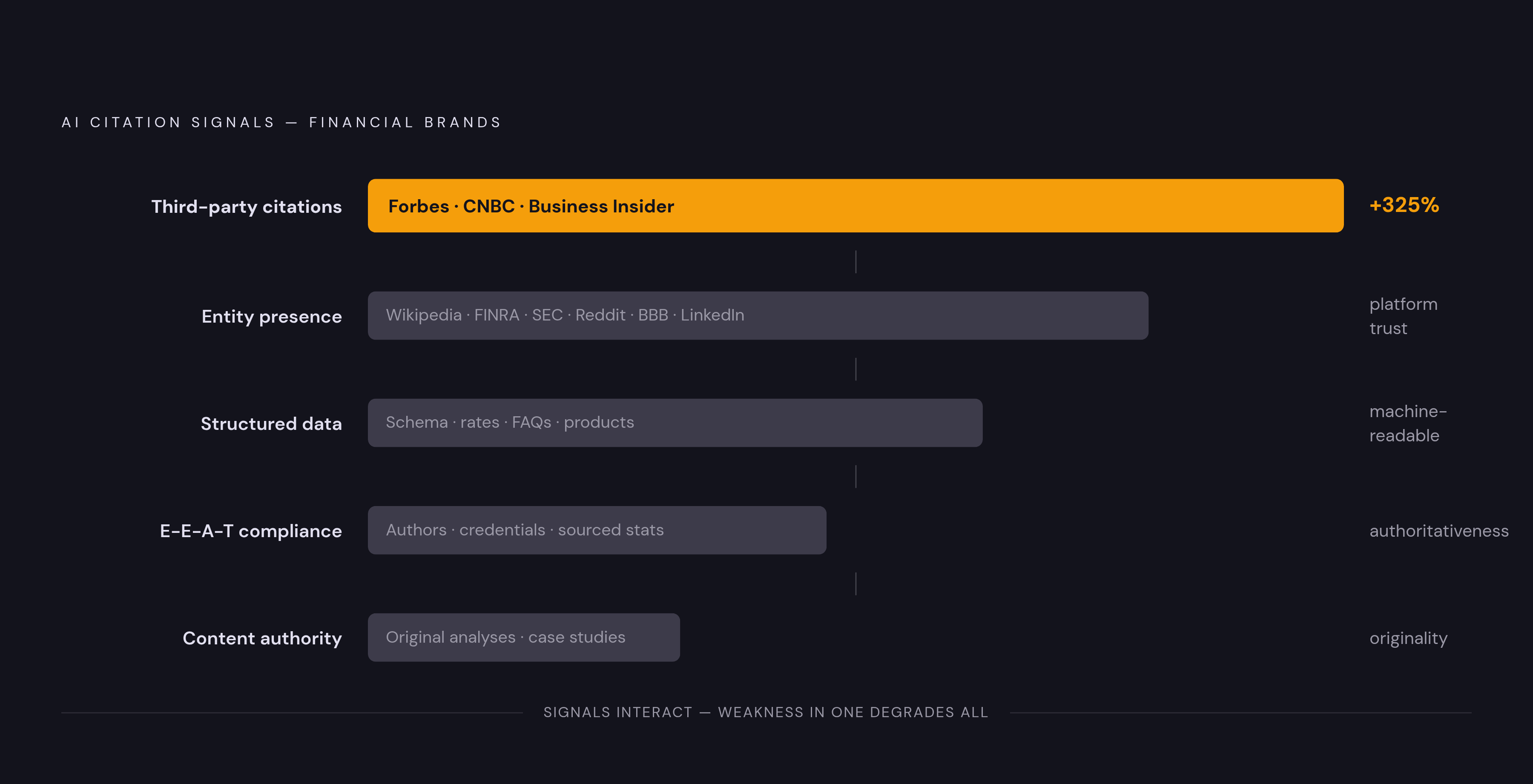
Financial marketers have historically had no unified system for measuring signals such as third-party citation density, entity presence on trusted platforms, structured data, E-E-A-T compliance, and content authority.
Third-party citation quality carries outsized weight because AI systems trust what human editors have already vetted. Frequent citation in outlets like Forbes, CNBC, and Business Insider strengthens both a brand's footprint in training data and its citation frequency in generative answers. This works like a Matthew effect: distributing content across a wide range of publications, instead of publishing only on a brand's own site, can increase AI citations by as much as 325%. Early investment in getting covered by credible outlets pays off disproportionately later, because the advantage compounds rather than staying flat.
Entity presence on the specific sources generative engines rely on matters just as much. These engines draw heavily from a narrow set of trusted sources, among them Wikipedia, Reddit, a handful of top-tier publications, and specific industry forums, so a brand that shows up consistently across that small set gets pulled into synthesized answers even when its own website is never directly cited. In finance, the relevant platforms get specific fast: FINRA BrokerCheck, SEC IAPD filings, Google Business Profile, the BBB, Trustpilot, LinkedIn, ADVRatings, and Glassdoor each speak to a different client segment and a different kind of query. If you're a mortgage borrower comparing lenders, you're likely encountering Zillow and LendingTree data, but a wealth management client is more likely weighing BrokerCheck records against Google reviews, so the correct platform mix shifts by sub-sector rather than following one universal checklist.
Structured data and schema markup are the machine-readable backbone that makes all of this possible. Schema on services, FAQs, interest rates, and product details lets an AI system parse content types reliably and connect a brand to the correct nodes in its knowledge graph. Without that structure, even accurate, well-written content can go unrecognized simply because the model can't parse what kind of information it's looking at.
E-E-A-T compliance (experience, expertise, authoritativeness, trustworthiness) functions as a parallel authority signal. Author credentials, transparent sourcing, named experts identified by title and company, and statistics attributed to a named source all register with AI systems as markers of reliability. A 2026 comparative study of how LLMs evaluate financial disclosures found that models differ substantially on relevance, completeness, clarity, conciseness, and factual accuracy, which suggests that content demonstrating those qualities clearly gets cited more consistently than content that doesn't. The phrase "according to [named source]" carries more structural weight than an unsourced claim, because it maps directly onto the citation-validation logic these models apply in high-stakes domains.
Content authority closes the loop. AI models favor well-written, data-backed, informative material, and financial brands that publish original trend analyses or case studies get recognized as authoritative sources rather than aggregators repeating what others already said. A 2024 survey of LLM applications in finance categorizes existing research into areas like sentiment analysis and knowledge-based methodologies, a reminder that the content a brand publishes gets processed by the same kinds of models that later evaluate that brand's credibility, which raises the bar for how deep and specific that content needs to be. These five signals function as a constellation rather than a checklist: weak structured data undercuts strong editorial coverage, and a brand with no presence on FINRA BrokerCheck can't fully compensate with a well-written blog. Strength in one area raises the ceiling for the others; weakness in one drags the rest down with it.
Why AI query behavior in finance makes these signals more consequential
A user comparing retirement accounts or refinancing options tends to describe a full situation rather than type a keyword fragment, so a brand needs to be recognizable across a much wider range of phrasing and context than a single search term would ever require.
What makes this more consequential than a missed search ranking is how users treat the resulting answer. A user who clicks a search result can still reconsider other options further down the page; a user reading an AI-generated answer tends to treat that answer as a conclusion rather than a starting point. A brand left out of the answer doesn't get a second chance at that decision, because it was never part of the decision to begin with. Survey data puts this at scale already: 51% of consumers have used an AI tool to get financial advice or information, making the AI response layer a primary influence point somewhere in the financial purchase journey, not a niche one.
The ESMA and Alan Turing Institute report reinforces this by noting that LLMs are increasingly deployed for direct customer interaction in financial services. That positions the AI-generated response as a direct customer-facing communication channel in its own right, carrying the same weight a phone conversation with a representative might have carried a decade earlier.
One structural fact gives all of this a practical urgency. LLM perception of a brand typically lags behind content publication by three to nine months. A financial brand that starts strengthening its signals today should not expect to see that work reflected in AI outputs right away. What a model says about a brand this month reflects decisions and content published many months earlier. The cost of delay compounds quietly in the background while the brand waits to see results.
Measuring AI brand perception versus traditional financial brand monitoring
Classical tracking asks a narrow question: are we mentioned, and is the sentiment positive or negative? AI perception tracking has to ask several questions at once: which attributes does the model associate with the brand, how do those associations compare against named competitors, which objections keep recurring in AI-generated answers, and where do the model's claims contradict facts the company itself would assert?
This measurement discipline is no longer theoretical. Peec AI, in a product launch in September 2026, built a structured approach around brand perception extraction: the system identifies specific claims made about a brand inside AI responses, then marks each claim as contradicted, supported, inconclusive, or not covered, checked against facts the company has registered. Rostrum, a PR agency serving financial and professional services firms, built a parallel framework called the Brand Barometer, which runs systematic audits across Google AI Overviews, ChatGPT, Perplexity, and Microsoft Copilot using both branded and sector-specific prompts, scoring each response for presence, prominence, sentiment, and factual accuracy, alongside a full analysis of the traditional search landscape, including People Also Ask results, Related Searches, Knowledge Panel status, and the review and ratings environment.
Similarweb's 2026 Generative AI Brand Visibility Index adds scale to the picture. It defines brand mention share as the percentage of AI-generated responses that include a specific brand name, and it tracked that measure across more than 11,000 prompts within finance. That volume of tracking confirms the measurement already happens at an industry scale. A financial brand not doing its own measuring isn't operating with an incomplete picture so much as operating entirely blind to where it stands. Within that measurement, citation rate carries more weight than mention rate: a mention is a passing reference, but a citation means the AI engine is confidently attributing a specific fact to that brand, a qualitatively stronger form of recognition.
A multi-dimensional scoring framework for financial brand AI perception
Rigorous measurement of how AI systems perceive a financial brand needs to score at least three dimensions together, visibility, citation, and sentiment, layered with the finance-specific signals already discussed that decide whether a brand gets treated as a trusted entity or filtered out of the answer entirely. None of the three substitutes for the others.
Visibility alone, how often a brand appears across AI responses, is necessary to track but insufficient on its own. A brand can appear constantly in AI answers while being framed in a corrective or cautionary context, a pattern that makes sentiment measurement an essential complement rather than an optional add-on. Citation rate stands out as the single highest-value visibility signal, because it reflects confident attribution rather than incidental mention: a financial brand cited as a source is being positioned by the model as an authority on the subject, not simply referenced in passing.
Entity accuracy adds a dimension that general brand monitoring tools were never built to capture. This means checking whether the AI correctly identifies a brand's category, its products, its regulatory status, and its key claims. The stakes are specific to finance: a misattributed regulatory status or an outdated product description inside an AI answer can directly shape a consumer's decision in ways a generic brand-sentiment error would not.
The ESMA and Alan Turing Institute framework for evaluating LLMs in finance names robustness, data dependency, security, fairness, and accountability as core principles for responsible AI adoption, and argues that the sector benefits from having clear evaluation metrics and industry standards. That argument was built to describe how LLMs should be evaluated when performing financial tasks, but it applies with equal force to how brands get evaluated by those same LLMs. FinTrust's seven-dimension benchmark, covering trustfulness, robustness, safety, fairness, privacy, transparency, and knowledge discovery, offers a conceptual template for just how layered this trust evaluation problem actually is. Brand perception scoring in finance needs to match that complexity rather than collapsing everything into a single aggregate score.
Evident, among the organizations building toward this standard, scores across more than 70 indicators that span four evaluation pillars. The specific architecture varies across the organizations doing this work, but the underlying premise holds across all of them: a single visibility number cannot represent what a financial brand needs to know about how AI systems perceive it. The discipline that measurement requires looks a great deal like the discipline finance has always demanded of itself: multiple dimensions, checked against evidence, scored honestly rather than simplified for convenience.
Sources
- The Impact of Large Language Models in Finance: Towards Trustworthy Adoption
- FinTrust: A Comprehensive Benchmark of Trustworthiness Evaluation in Finance Domain
- How Large Language Models Source Brand Reputation Across Languages and Markets
- A closer look at how large language models 'trust' humans
- AI Perception Index 2026 How Large Language Models Position Brands in the AI Era by Faruk Tugtekin :: SSRN
- Financials Industry: 2026 AEO / GEO Benchmarks - Conductor
- How To Build Trust Signals That AI Systems Recognize | Thrive
- AI Search Trust Signals: The Practical Audit (2026 Guide)