A Structured Cadence for Monitoring and Correcting What LLMs Say About Your Brand
A steady weekly-to-quarterly rhythm turns AI brand audits into assigned fixes.

An AI brand perception audit and scoring program repeatedly queries AI assistants, measures presence, tone, and factual accuracy, and turns gaps into assigned corrections. Managing what LLMs say about your brand requires a repeatable cadence. A stable prompt panel, weekly and fortnightly checks, and monthly and quarterly reviews make that cadence practical.
Why LLM outputs have become a primary brand-shaping force
With 50% of consumers already using AI-powered search, AI-generated summaries, comparisons, and recommendations can shape how people see a brand before they visit its website. Sometimes that impression is the only one. A buyer may never consider a brand that is left out, however high it ranks in search or how much it spends on marketing. The model has become a gatekeeper, and it does not owe the marketing team a meeting.
Malthouse et al. (2026) found substantial omissions of established brands in category-only queries, showing that conventional popularity does not reliably translate into model prominence. Familiarity is not a guaranteed seat at the table. A rank tracker can show that a brand is doing well while an AI assistant recommends someone else.
How LLMs decide which brands to surface — and why the mechanism makes passive monitoring useless
LLM brand selection is probabilistic. The same prompt can return different brands and rankings. One response therefore shows what happened on that occasion.
Two layers shape the answer. Pre-training builds statistical associations between a brand and a topic from the frequency and context of mentions across diverse, high-quality sources. When an engine has web access, retrieval-augmented generation, or RAG, adds information it finds in real time. Perplexity, for example, retrieves and cites live pages, making freshness, site structure, and load speed relevant to citation eligibility.
The same study links prominence to how much people search for a brand and talk about it online, with brand size and ad spend showing less of a link. Once a brand is included, documented attributes can be more important than prominence in determining first place. Meanwhile, training cutoffs leave models behind recent rebrands, acquisitions, and pricing changes, creating room for incorrect synthesis from historical patterns. Repeatable monitoring is needed because both selection and the evidence behind it can vary.
The three dimensions a monitoring cadence must actually track
Presence measures whether the brand appears and where it sits among the competitors named in the answer. The study uses Brand Recommendation Probability, or BRP@k, and Mean Reciprocal Rank, or MRR@k, to capture recommendation probability and rank prominence through repeated sampling. Those are distinct questions. A brand that appears regularly but sits behind competitors has a different problem from one that rarely appears at all.
Tone measures how the model frames the brand when it appears, including confidence, skepticism, and uncertainty. Positive wording is not the whole story. “Might be suitable for” gives a recommendation less persuasive force than “excellent for.” A presence score cannot reveal that difference. Counting mentions alone can flatter the dashboard while missing the hesitation in the answer.
Accuracy measures whether pricing, features, differentiators, and policies are correct. When review sites, old press releases, and the current website disagree, the model can blend their claims into an account that gets the facts wrong. These dimensions need separate scores because omission, hesitant endorsement, and invented pricing point to different corrections.
What the signal research says about which inputs actually move LLM brand representation
Diverse, authoritative third-party mentions are the dominant lever for inclusion, while owned content volume contributes little on its own. More pages are not automatically more evidence. Independent reviews, industry publications, and technical documentation give models cross-source support for a brand’s category fit.
GoBlinkly’s AI visibility audits across B2B SaaS clients found an association between positioning clarity, third-party validation density, and structural accessibility and citation frequency: brands in the top quartile were cited more than four times as often as brands with gaps in any one dimension. The Malthouse study also found that needs-based prompts can retrieve brands omitted from generic category queries when distinctive positioning cues are supplied. That gives weaker-presence brands a correction path through well-documented differentiators, with fresher evidence able to reach retrieval-enabled engines sooner than training-only models.
Building the prompt panel — how do you find out what AI chatbots say about your brand?
What do you actually query? Start with a standing panel that reflects how buyers, journalists, partners, and critics ask about the category. Include commercial questions about vendors for a use case, head-to-head comparisons, complaints and risks, and factual questions about pricing, features, and policies. Add the five topics the brand would least want a model to improvise on. Those are not always the questions marketing most enjoys asking.
Include needs-based and contextual prompts as well as generic category questions. A model may omit the brand from a broad recommendation yet retrieve it when a buyer supplies specific goals or constraints. That difference reveals positioning specificity as well as visibility. Add paraphrase variants of high-stakes commercial prompts because retrieval can be sensitive to wording and query language.
Running each prompt more than once takes the record beyond one lucky or unlucky response. The aim is a reliable estimate of mention probability. New questions from sales calls, support tickets, and competitor moves should enter the panel on a schedule. Keep the core commercial prompts stable, however, so changes in results do not simply reflect changes in the questions.
The weekly and fortnightly cadence — catching drift before it compounds
About 65% of cited sources change within a two-week window, so checking only once a month can miss shifts that matter. Weekly monitoring reflects the volatility of the evidence feeding answers. The most frequent checks should therefore focus on commercial prompts where a changed recommendation or a wrong fact needs to be flagged quickly.
Each week, run the core commercial prompts repeatedly across ChatGPT, Gemini, Perplexity, and any other engine relevant to the category. Record whether the brand appears, its position among named competitors, and any shift in tone. Flag new hallucinations or factual errors immediately. Compare engines at this frequency because one engine’s answer cannot stand in for the others. A clean result in one is not a clean bill of health everywhere.
Every fortnight, expand to the full panel, including buying-intent queries, long-tail comparisons, and paraphrase variants. Check whether brands left out of core queries appear when prompts include needs or constraints. That tests whether distinctive positioning is reaching the model. Look at which competitors fill the brand’s empty slots and how the model describes them. Feed those gaps into the correction backlog so the next review has something to decide.
The monthly and quarterly cadence — scoring trends and updating the correction backlog
Add prompts from the previous month’s sales conversations, support tickets, and competitor positioning shifts while preserving the stable core. Then review presence rate, tone consistency, and factual accuracy to see whether earlier corrections have taken effect. Separate widening gaps from stable ones and new errors. The backlog needs priorities.
Each quarter, produce a complete report covering mention-rate trends, sentiment, accuracy, and competitive share of voice across tracked engines. Assess BRP and MRR against both the competitive set and the brand’s own previous results. Relative movement changes the interpretation. A gain in mentions offers a different picture if competitors have gained more.
Use the quarterly meeting to assess cross-model perception drift and whether differences between engines have widened or narrowed. Revisit the panel for new products, markets, and competitors, retiring questions that no longer reflect buyer behavior without casually discarding the comparison base. Track progress toward an 80%-or-higher positive or neutral sentiment rate on commercial queries and answers that get nearly all the facts right. Assign a named decision-maker to each review layer, or the schedule becomes a collection of good intentions with calendar invitations.
Correction paths ranked by how fast they reach the model
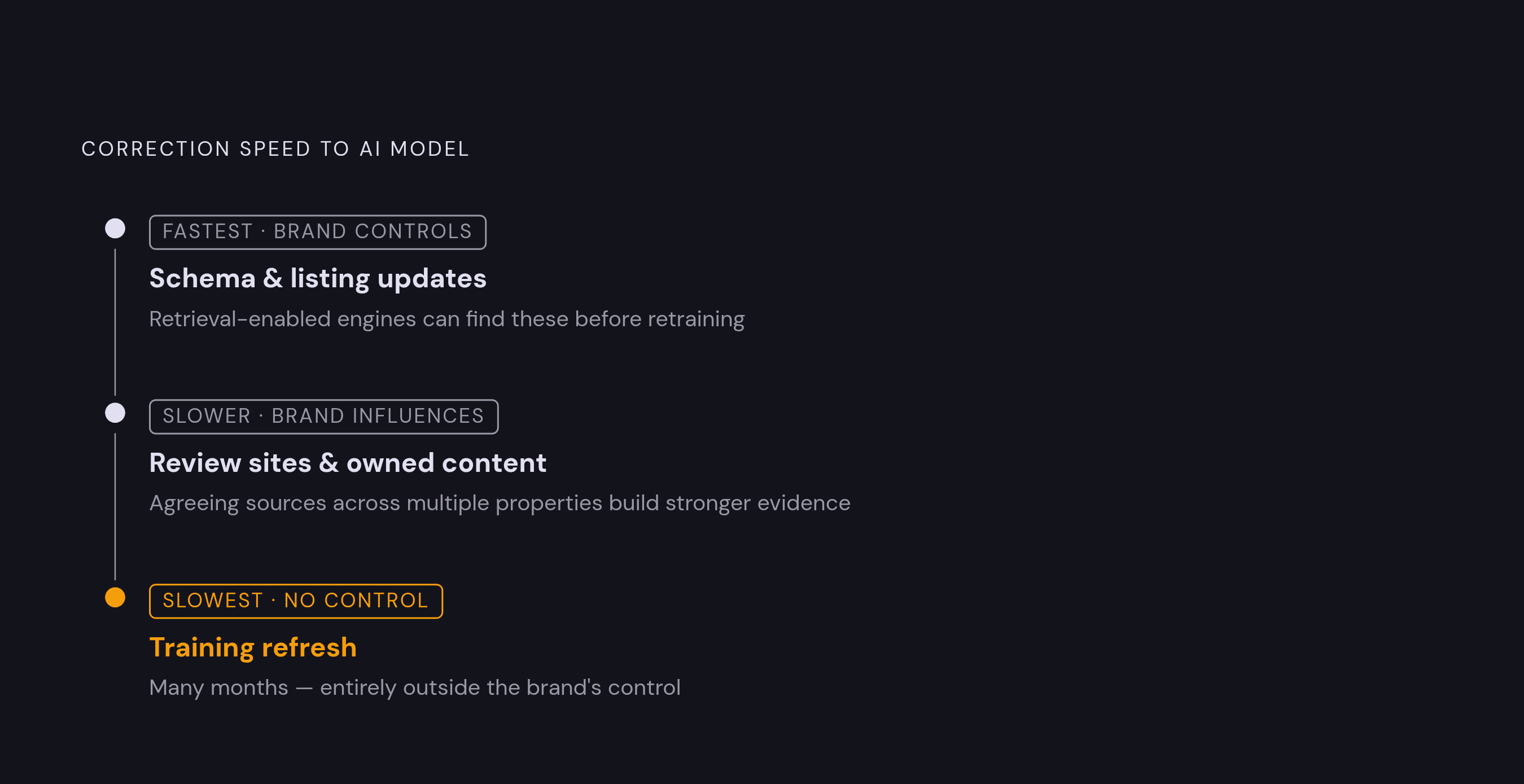
Once an error appears, the correction method should match its urgency and the layer supplying the answer. Start urgent factual corrections with schema and listings. These update information that retrieval-enabled engines can find before the model is retrained. The evidence so far gives no basis for promising when a correction will take effect or that citations will rise.
Next, carry the correction over to independent review sites, publications, and the brand’s own structured content. A correction in one source is fragile. When sources agree, they give the model stronger evidence than one updated page among others that still make older claims. This route is especially valuable for brands with weaker baseline presence, which depend more on retrieved attribute evidence than on established model associations.
Waiting for a training refresh belongs last. It can take many months and sits outside the brand’s control, so it is not a viable response to an urgent error. For models relying on training data alone, that delay is a structural constraint. Assign each backlog item a correction method and a deadline, then use the scheduled runs to assess whether the answer changes. The deadline governs the team’s work.
Making the cadence an operational discipline, not a one-time project
Assign one cadence owner, with weekly and fortnightly runs delegated where useful. Monthly trend reviews and quarterly assessments still need a named decision-maker who can authorize corrections and allocate resources. Someone must be able to act on the score. Without that authority, monitoring becomes an efficient way to document the same problem again.
Connect presence, tone, and accuracy to existing brand health reporting, including SEO performance, review sentiment, and share of voice. A separate dashboard that gets opened once a quarter is a filing cabinet with better graphics. The same reporting also shows which brands fill empty slots, how models describe them, and which queries reveal that a brand’s positioning is vague. Those findings can inform product, messaging, and PR strategy as well as factual corrections.
For teams evaluating measurement tools, the relevant criteria follow from this workflow, including separate dimension scores, cross-engine comparison, repeatable measurement, and correction prioritization. Evident’s scoring approach combines algorithmic, AI, and human evaluation dimensions and prioritizes what to fix first. A tool’s role is to make the program manageable.
Only 16% of brands track how they do in AI search results in a systematic way, so teams that check regularly have room to get ahead in how they measure them. A stable prompt panel, repeated queries, and a named owner are a small enough start to make this week. Over two or three quarters, those runs can reveal which gaps are structural, which respond to correction, and where new risks are forming. A one-time auditor can collect answers. A team running the cadence builds the history needed to understand them.