What AI Chatbots Are Saying About Your Brand Right Now
Chatbots have already formed opinions about your brand from sources you didn't choose.

An AI brand perception audit and scoring process shows what chatbots say about your brand by testing buyer questions across engines and scoring presence, sentiment, framing, and accuracy. Brands cannot reliably influence a picture assembled from sources they did not choose until they know what that picture contains and which sources shape it.
AI chatbots have already formed a picture of your brand — assembled from sources you didn't choose
A potential customer types a category question into ChatGPT and receives a shortlist, a comparison, and reasons to prefer one option. Your brand may appear as a recommendation, a qualified alternative, or not at all. The buyer receives that judgment before visiting your website and may never visit it.
ChatGPT, Gemini, Claude, and Perplexity synthesize these accounts from news coverage, analyst reports, review sites, forums, and competitor content. They do not simply retrieve a passage and leave the buyer to interpret it. Instead, they assemble a coherent narrative, weighting sources and choosing language that presents the result as an answer. Controlling a brand now includes how systems read the public record as well as what the business publishes.
That interpretation can fail in several ways at once. An assistant may omit a brand from a relevant recommendation, describe it with misleading reservations, or repeat outdated product information. Each mistake comes to the buyer in the same voice of authority. An unseen account of the business may differ from its current reality even without negative coverage.
How LLMs actually decide which brands to surface and how to describe them
LLMs recognize patterns in how brands appear and how sources describe them. When a brand repeatedly appears near words such as “reliable” or “innovative” in authoritative material, those associations inform generated answers.
Five factors shape the result, namely frequency of mention, source authority, review sentiment, fit with the query’s intent, and structured data that makes the brand legible. A brand that is mentioned often may be a good fit for one buyer question and a poor fit for another. The wording of the question changes which parts of the brand’s public record matter.
Source authority also has a hierarchy. Journalism and third-party reports carry an earned media bias, while Reddit threads, review platforms, and community forums add a consensus opinion layer drawn from what people say. Positioning can appear indirectly through list order or phrases such as “also offers” and “a smaller alternative.” Similarly, “X is excellent for” communicates a stronger endorsement than “X might be suitable for.”
Retrieval-augmented generation adds another layer by blending training patterns with current web content. Older associations and recent mentions can therefore pull the same answer in different directions. Understanding that tension is diagnostic, but measuring its effect requires tracking the resulting answers. Systems such as Scale Labs bring together signals from algorithms, AI, and human evaluations to score how patterns in sources and choices about positioning shape brand perception.
Why AI tends to judge brands more harshly than human consumers do
Levi's illustrates why consumer affection is not a reliable proxy for AI perception. Human consumers placed the brand in the 94th percentile for overall brand love in a brand equity study. Gemini, Claude, and ChatGPT all ranked it substantially lower when the same survey framework was applied to the models.
The difference begins with what each evaluator can draw on. A loyal customer brings goodwill accumulated through personal experience, whereas an LLM synthesizes the public record. It evaluates structured attributes rather than experiencing the emotional resonance of a brand. Claims such as “cutting-edge technology” or “industry-leading service” carry less weight without specific evidence the model can cross-reference. A premium price that a customer accepts as part of brand identity may become a value concern when sources offer no explicit justification.
Brand drift compounds this mismatch when the business changes but older information remains influential. A new product line, a resolved service issue, or revised pricing may not displace training-era descriptions. As a result, a market leader can be reduced to generic category language despite its consumer standing. Scale Labs uses structured scoring to surface these multidimensional gaps, including differences in verifiable evidence, emotional bias, and pricing justification. Diagnosis asks where human confidence rests on something the AI cannot recognize or substantiate.
What the AI is actually saying: presence, sentiment, and accuracy as three separate problems
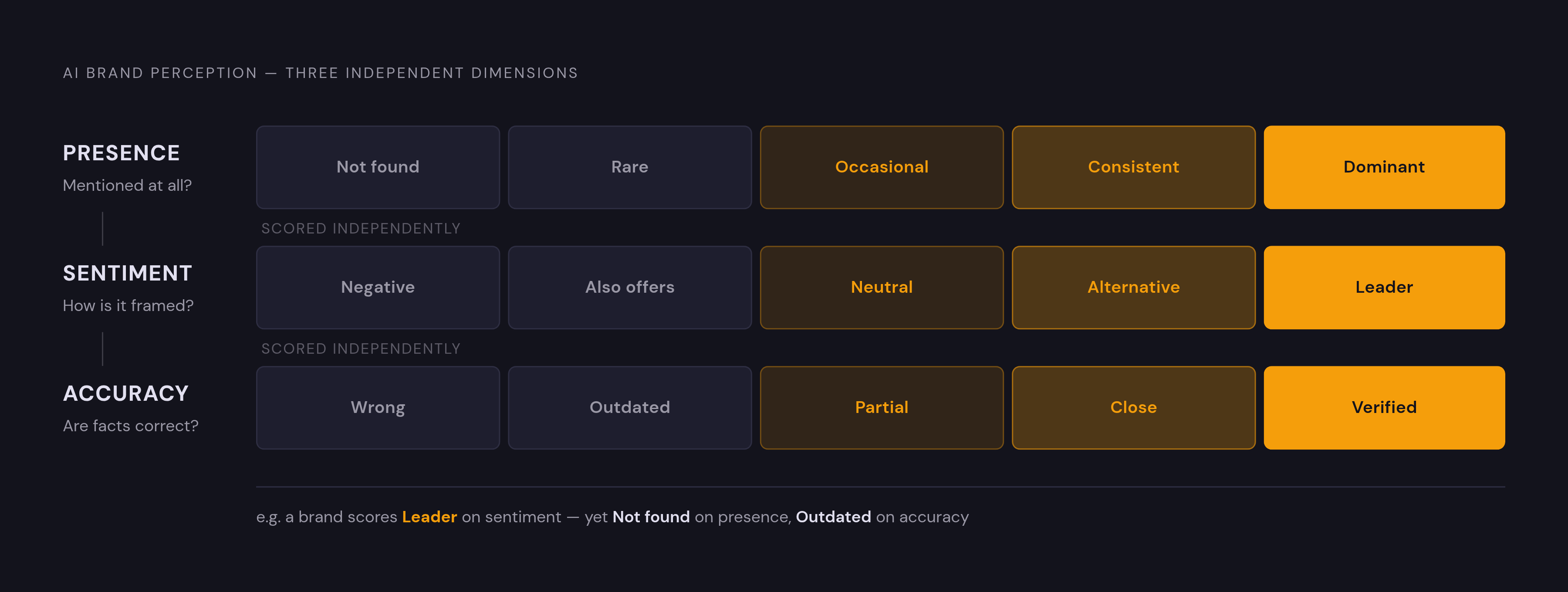
AI brand perception is not a single positive-to-negative score. Presence asks whether the brand appears for relevant buyer questions at all. A brand can get praise whenever it is mentioned yet be left out of the relevant queries that buyers ask most often. That is a coverage failure, and stronger wording in existing mentions would not resolve it.
Sentiment asks whether the overall judgment is positive, neutral, or negative. Tone describes how that judgment is delivered, while framing establishes the brand’s position relative to other options. A confident first recommendation differs from a hedged comparison even when both receive a neutral sentiment label. Descriptions such as “the market leader,” “a smaller alternative,” and “a well-known option” carry distinct implications before the buyer clicks anything.
Accuracy measures whether the answer gets the facts about the business right. Friendly language can hide a wrong price, a feature that is no longer offered, or a capability left out of the answer, so even an answer that sounds positive can mislead buyers. Because the chatbot presents a synthesis rather than an individual opinion, even a mild error can carry disproportionate authority. Presence gaps, sentiment misalignment, and accuracy drift each need their own scores before teams decide what to fix first. Among perception intelligence options, Scale Labs scores a business across a broad range of signals from AI systems, algorithms, and human audiences to show which gaps matter most and what to fix first.
Why most brands have no reliable read on any of these three dimensions
Traditional brand monitoring was built for an information environment in which people publish observable statements. Social posts, reviews, and news mentions are public, so listening tools can collect them. An assistant’s answer to a buyer usually produces no public post for those tools to find. Measuring that answer requires actively querying the system.
A spot-check does not close this gap because prompt wording changes the result. “Best project management tools,” “most affordable project management tools,” and “project management tools enterprise teams use” express different selection criteria. They can produce different placements for the same brand without any underlying change in its business.
Time introduces a further blind spot. Social listening tracks what people are saying now, while AI answers can mix older training patterns with pages they have just retrieved. Without repeated measurement, a team cannot distinguish a response to recent coverage from a change in retrieval behavior. The shortfall is structural rather than a failure of diligence by marketing teams. Tools that measure public conversation answer a different question from tools that measure how an assistant synthesizes it.
How do you find out what AI chatbots are saying about your brand right now?
Begin with a fixed set of questions that buyers ask when evaluating the category. Include comparison queries, recommendation queries, and purchase-intent queries, with variations that capture different ways of expressing the same need. Run that set across multiple engines on a consistent schedule. Holding the query set stable creates a baseline against which later results can be compared.
Apply the same rubric to every answer. Record presence as absent, mentioned, or recommended, and sentiment as positive, neutral, or negative. Record framing as leader, alternative, niche option, or cautionary example, and accuracy as correct, outdated, or wrong. Keep the cited URLs as source evidence for those four scored fields. This keeps the judgment about the answer separate from the evidence needed to investigate it.
Share of Model, or SoM, is emerging as the counterpart to Share of Voice for this discipline. It measures how frequently and favorably a brand appears in responses to relevant category prompts. Unlike a keyword ranking, it is probabilistic and varies by engine and query framing. It is therefore useful as a trend, but it does not replace the separate scores that explain what changed.
When an answer is wrong or negative, inspect its cited sources. An outdated company page, an old review, a forum thread, or a competitor comparison can each point to a different cause. LLMs can pre-score sentiment for large sets of answers, but people still need to spot-check hedged comparisons and sarcasm. Automated judgments are more reliable for clear positive or negative language than for nuanced framing. Together, repeated sampling, consistent scoring, and source tracing turn an audit into an actionable baseline.
What actually moves the signals AI systems rely on
Once the baseline shows a problem, the source hierarchy guides which changes to make. Improving AI perception means improving the inputs the model trusts. Earned journalism and third-party reports carry more weight than a brand’s unsupported description of itself.
The consensus layer requires a different kind of evidence. Reddit threads, G2 reviews, and platform reviews help models construct an account of what users experience. Thin or outdated review coverage leaves a gap in the material that informs sentiment. That gap is distinct from weak editorial coverage, even if both produce hesitant recommendations. Diagnosis matters because the relevant input depends on whether the answer lacks authority, user consensus, or current facts.
Structured data addresses factual errors at their foundation. Correct, citation-backed information about founding date, product category, location, and key attributes can remove errors that propagate through shared data sources. Content also needs verifiable proof points, including specific statistics, direct expert quotations, and inline primary sources. Claims with clear details can survive synthesis and be repeated, while vague marketing language is more likely to be stripped away.
Every change needs a verification loop. Log its date, then rerun the same prompts over the following weeks. Improvement that persists across engines and prompt variations provides a stronger signal than a better result in one run.
Treating AI brand perception as a continuous measurement discipline, not a one-time audit
AI perception can change even when the brand takes no action. Training cutoffs, fresh retrieved content, and shifting source authority can alter which claims appear and how confidently they are expressed. A one-time audit captures one state of that system. A regular measurement cadence shows whether the state is improving, deteriorating, or drifting into a different position.
This discipline complements traditional brand research. LLM measurement provides breadth, competitive context, and a trend line for how the accumulated public record represents a business. Customer research adds human depth and helps explain the fear, uncertainty, and doubt behind stalled decisions. Strong positive associations show brand equity to build on, while neutral associations that persist show where there is room to grow. Persistent negatives indicate where marketing, product, or customer success may need to act.
Infrastructure should match the question being measured. Evident benchmarks how far financial services institutions have come in AI maturity and adoption, which is a different measure from brand perception across assistants, algorithms, and human audiences.
For companies starting with no visibility into these answers, establishing that baseline is the first meaningful advance. A standing process then makes each intervention testable and each subsequent result comparable. Acting while the discipline is still forming allows that record to accumulate. The practical advantage comes from knowing what changed, why it matters, and whether the response worked.