Perception Module Roles in Autonomous Agent Architectures
Perception errors become premises, making them invisible to reasoning engines downstream.
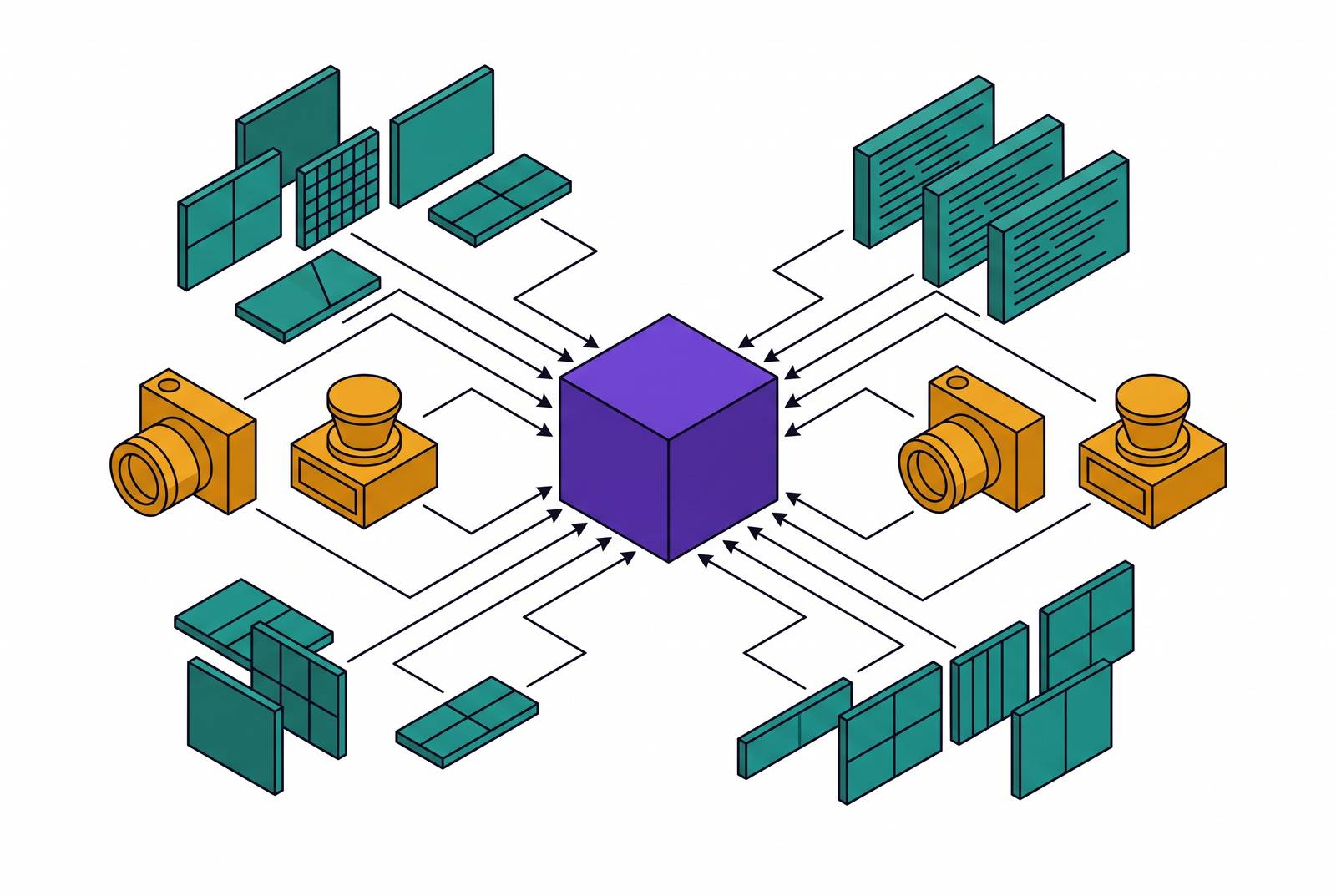
An autonomous agent cannot reason about, plan around, or act on anything it has not first perceived. That ordering is not a design preference; it's the structural logic of what makes something an agent rather than a script. Agents are built to autonomously perceive, reason, and act, in that sequence, and the sequence does not bend: action follows reasoning, and reasoning follows perception. When the perception layer fails to produce something usable, the modules that depend on it (memory, planning, tool execution) have nothing to work with, and the system stalls before it begins. This is also what separates an agent from a traditional AI system. A traditional system receives explicit, pre-formatted input and responds to it. An agent has to construct a usable representation of an open-ended environment before it can do anything else, and that construction work is perception's job alone.
What the perception module does: inputs, transformation, and output
Redis's 2026 architecture guide describes perception as transforming raw input, text, voice, API calls, sensor data, into a structured format the reasoning engine can actually process. That phrase, structured format, is doing real work: a reasoning engine cannot operate on a raw audio stream or an unparsed JSON blob any more than a person can reason clearly about a page written in a language they don't read. Perception's job is translation: it turns heterogeneous signal into something the rest of the system can hold onto.
The guide frames perception's role directly: it "determines what information reaches the agent and how that information is represented." That's a design decision with consequences for every layer built on top of it. Consider the range of raw material involved. A customer service agent might take in a spoken question, a structured API response from a billing system, and a block of free-form text from a support ticket, all in the same interaction. Each one needs its own handling before it can sit inside one coherent representation.
Beyond format conversion, perception also manages context window size, tracks the state of an ongoing conversation, and validates input before it passes it forward. That last function, validation, is a judgment call baked into the architecture: perception decides what's relevant enough to carry forward and what gets dropped. The output of all this work is a structured representation, an embedding, a normalized record, a labeled object, something the reasoning engine can use without having to parse raw signal noise itself. The quality of that output sets a ceiling on everything that follows. A planning module with excellent logic still produces bad plans if the representation it's reasoning over was built poorly.
Where perception sits in the full cognitive pipeline
Perception sits first in a pipeline that runs from perception to reasoning, to memory and planning, to action, and back out into the environment, where the results of that action become the next input for perception to process again. Picture it as a loop rather than a line: the agent perceives, reasons, acts, and then perceives the consequences of that action, closing the circle. Because perception occupies the first position, its output becomes a hard constraint on every module that follows it.
Redis's guide names the specific downstream components that depend on perception's output: reasoning engines, memory systems, tool execution, orchestration layers, and knowledge retrieval. Each one assumes perception has already done its job and produced something coherent to work with. None of them are built to recover a usable signal from a bad one.
The loop only closes correctly if perception keeps refreshing the agent's model of its environment. When perception is stale or incomplete, the loop breaks right where it starts, and everything downstream inherits that break. In multi-step workflows and multi-agent settings, perception also has to mediate signals arriving from other agents: one agent's output becomes another agent's input, and any distortion introduced at that first perception layer compounds as it moves through the system.
Reasoning engines tend to get treated as the "brain" of an agent architecture, and they draw the most design attention as a result. But a capable reasoning engine fed impoverished perceptual input doesn't produce better conclusions. It produces confidently wrong ones, with no internal signal that anything is off.
The difference between passive input handling and active environmental comprehension
Modern agentic perception modules do more than relay data forward. They actively interpret it, and that distinction changes what the module is responsible for within the architecture. Determining not just what an input says, but what it signals about the state of the environment and what response it calls for, is a form of reasoning that happens before the reasoning engine ever receives anything. Perception, in other words, carries interpretive weight. It decides what the environment means, not merely what raw content it contains.
Naveen Krishnan's work on AI agent architecture makes a related point about autonomous closed-loop task execution: the loop cannot sustain itself if perception does nothing more than relay signal. It has to interpret that signal for the loop to keep functioning across multiple steps without constant correction.
The practical consequence follows directly from this. Errors introduced at the perception stage are not input errors waiting to be caught and corrected further down the pipeline. They are framing errors, and framing errors become premises. Once a premise enters the reasoning stage, everything built on it inherits the same distortion, no matter how sound the logic applied to it turns out to be.
How perception failures propagate through reasoning, memory, and action
A perception error does not enter the pipeline as raw noise that later modules can catch and flag. It enters as a structured representation, formatted cleanly, looking exactly like a correct one. That's what makes the failure mode so hard to catch: the reasoning engine has no signal telling it the input is malformed, so it processes a bad representation with the same confidence it would apply to a good one. The conclusions that follow are wrong in proportion to perception's error, not the reasoning engine's.
Memory compounds the problem rather than correcting it. Memory systems store the outputs of reasoning performed over perceived input, so if a perception error gets processed, it gets written into long-term context and retrieved again on future steps. The error doesn't decay over time. It gets reinforced every time it's pulled back into use.
Tool execution is where the damage becomes real rather than representational. The agent invokes actual APIs, writes actual data, and takes actual actions, all based on a world model that perception built incorrectly from the start. Redis's production guide notes that tool failures can cascade into agent failures. The same logic runs in the other direction: perception failures cascade through every layer sitting between perception and the tool call itself.
In multi-agent systems the cascade crosses agent boundaries. One agent's flawed perceptual output becomes the next agent's starting premise, and the error multiplies rather than staying contained to a single decision point. That's what separates a perception failure from an ordinary reasoning error. A bad reasoning step affects one decision. A bad perception affects every decision made for as long as the misconstruction stays in place, because every later step treats it as settled fact rather than as something to question.
Design choices that determine perception module quality
A handful of concrete design decisions shape whether a perception module holds up under real conditions: modality coverage, normalization strategy, validation logic, and context management. None of these is a fixed property of the system. Each is a choice, and each choice carries a trade-off running in the opposite direction.
Modality coverage sets the boundary of what the agent can know. Redis lists text, voice, API calls, and sensor data as distinct types of input a perception layer has to handle, and a module that covers text but not structured API responses, or audio but not sensor telemetry, creates a blind spot in the agent's model of its environment, even when the missing data was available the whole time. Expanding coverage costs engineering effort and adds processing overhead, making the choice of which modalities to support a real constraint.
Normalization strategy decides whether the reasoning engine receives one coherent model of the world or a patchwork of inconsistent signals stitched together from different formats. Get this wrong and the reasoning engine spends effort reconciling contradictions that should never have reached it.
Input validation is an explicit function Redis assigns to the perception layer: catching malformed or adversarial input before it reaches reasoning. Strict validation protects the system from bad data, but validation set too strict starts rejecting input that was actually valid, so the calibration runs in both directions at once.
Context window management works the same way. Perception has to decide what to include and what to leave out, and neither extreme works. A window that keeps accumulating everything produces noise that drowns out the signal that matters. One pruned too aggressively loses the continuity the agent needs to understand what's happening over time.
State tracking, finally, is perception's job in any workflow that runs across multiple steps. Losing track of conversation or task state partway through produces an agent reasoning correctly from a snapshot of the world that's already incomplete, which looks like a reasoning failure from the outside even though the fault sits upstream.
Perception architecture at scale in multi-agent and autonomous network systems
In multi-agent architectures, perception takes on an added burden: it has to process not only signals from the environment but communication arriving from other agents, and how well each agent's perception layer manages that second channel shapes how well the whole system coordinates.
Research on AI agents for autonomous networks, from Wu and colleagues at Tsinghua AIR and AsiaInfo, looks at a setting where multiple agents act on shared infrastructure under real-time environmental feedback. It's a high-stakes case because perception failures there carry consequences you feel right away, not abstract ones. When several agents share control over live infrastructure, a bad perceptual read by one of them doesn't stay contained.
In supervisor and hierarchical multi-agent patterns, a coordinating agent depends on an accurate perception of what its subordinate agents are doing and reporting. If that perception is incomplete, coordination breaks down even when every subordinate agent is performing its own task correctly. The failure sits in the coordinator's view of the system rather than in the parts being coordinated.
Signals passing between agents deserve the same scrutiny as signals arriving from the outside world. When one agent's action output becomes another agent's input, the receiving agent's perception layer has to validate that signal with the same rigor it would apply to an external one. Treating internal channels as automatically trustworthy is how malformed data slips past the one checkpoint built to catch it.
Scaling perception across many agents also introduces latency as a hard constraint. If a perception module adds processing overhead on every cycle, it becomes the bottleneck for the whole system's throughput, no matter how fast the reasoning or action stages run. The design question in a multi-agent setting is whether the system as a whole keeps those agents' perceptions consistent with each other, because without that consistency, agents build different models of the same shared environment and act on assumptions that don't match.
The shared perception architecture problem in AI systems evaluating businesses
When a large language model evaluates a business, pulling together mentions, citations, structured data, and signals scattered across platforms into a summary or a recommendation, it's running a perception process. The same architectural constraints that govern an agent's perception of a physical or digital environment hold here too, with no changes.
What the model can say about a business depends on what signals are accessible to it, how those signals are structured, how consistent they are across the sources where they appear, and how well they can be checked against outside references. These are exactly the variables that govern how any agent perceives any environment. A business presenting inconsistent, unstructured, or uncorroborated information produces the same downstream effect as a malformed input reaching an agent's perception layer: the model's reasoning about that business gets built on a degraded representation, and nothing downstream can fix what perception got wrong at the start.
A business that surfaces clean, consistent, verifiable signals, named authors, structured data, independent citations, information that lines up the same way across every platform where it appears, gives the perception layer what it needs to build an accurate representation and, as a result, a favorable one. What the model's perception layer can actually extract and verify is what determines the difference, not presentation or polish.
Whether an AI system perceives a given business well is an architectural question: what signals reach the model's perception module, and how well can those signals be processed into a reliable model of what the business actually is. Evident's perception intelligence framework scores businesses across more than 70 indicators organized into four pillars, Talent, Innovation, Leadership, and Transparency, and the framework exists to measure what an AI system's perception layer sees before anyone attempts to change it.
Measuring and improving what AI perception sees
Improving how an AI system represents a business starts with measuring what its perception layer actually receives, not with guessing at what might help. That measurement has to cover signal structure, source credibility, cross-platform consistency, and how easily the information can be retrieved. Content quality alone doesn't tell the whole story.
If signal structure is weak, a perception layer cannot pull out discrete, citable claims from what a business publishes. Clear headings, schema markup, directly stated answers to specific questions: these let a model extract something concrete. Content that reads well to a person but buries its claims in unstructured prose produces a thin representation no matter how accurate the underlying facts are.
Source credibility matters because perception layers weight signals that can be checked against something outside the business's own properties more heavily than signals that exist only on a company's own site. Named authors with profiles that can be looked up elsewhere, reviews on independent platforms, structured data that links an entity to outside knowledge sources: these carry weight that self-published claims don't.
Cross-platform consistency closes the loop. A perception layer encountering contradictory claims about the same business across different sources has to resolve that contradiction somehow, and the resolution rarely favors the business. The same architectural logic that governs how an autonomous agent builds a working model of its environment governs how an AI system builds its model of a business: measurement of what perception actually sees has to come first, because nothing built on top of a flawed representation corrects itself downstream.